Course overviewCourse progress
Module 02 of 08

Growth and the integral

Titre is not set by how many cells you reached. It is set by how many cells you had, multiplied by how long you kept them, multiplied by what each one made.

Module story ยท 3:13Watched

The area, not the peak

A three-minute story with two challenges. Build the integral from the stack, then choose a harvest day.

Read the transcript

A cell count hands you two numbers and people routinely collapse them into one. Total cell density is how many cells are in the sample. Viability is what fraction of them are alive.

The product of the two is viable cell density, and that is the only one that makes product. Early in a run viability sits near 98% and the two track each other closely. Late in a run they separate sharply, and that is exactly where your harvest decision lives.

Growth rate is defined the same way as in any other organism. The natural log of the density ratio, divided by the time between the two readings. For CHO it is quoted per day, not per hour, and a healthy doubling time lands around a day. A microbial culture does the same thing in well under an hour.

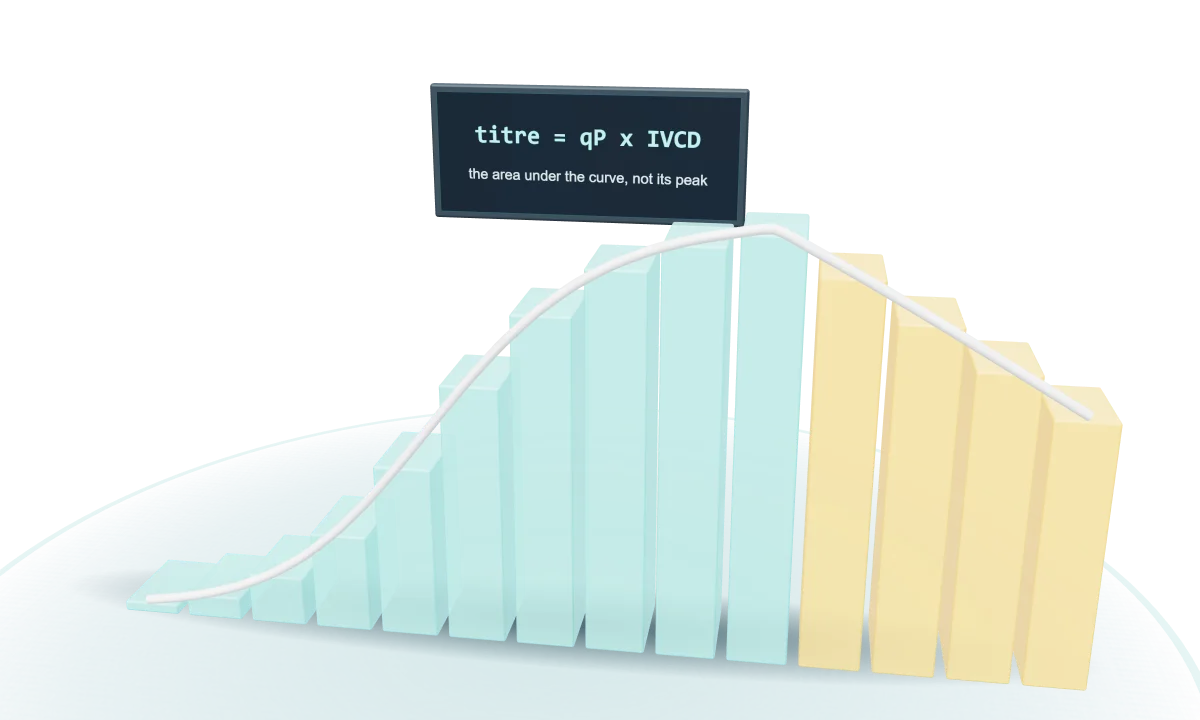
Here is the integral, drawn as one slab per day, each as tall as that day's viable cell density. A hundred cells for ten days and a thousand cells for one day give you the same cell days, and cell days are what becomes product.

This is the peak. It is one day out of fourteen. Titre follows the whole stack, not the tallest slab, and people quote the peak because it is the easiest number to remember.

The amber slabs are the last four days. Density is falling there and the integral is still being added to, which is why a run that holds a lower density for longer can beat one that spikes and crashes.

Your turn. Tap the part of this stack where the density is falling and the area is still growing. Challenge: Where is the density falling while the area still grows? Answer: The declining days (3), which are still adding to the integral.

Add the slabs with the trapezoid rule. The time step, times the first reading halved, plus every middle reading, plus the last reading halved. The rectangle rule overstates it.

The units are kinder than they look. Titre in milligrams per litre, divided by the integral in millions of cell days per millilitre, gives specific productivity in picograms per cell per day directly. The two factors of a billion cancel.

Quick estimate. A run ends at 1,200 mg/L, with an integral of 40 million cell days per mL. What was each cell making? Challenge: Titre 1,200 mg/L, integral 40e6 cell.day/mL. What is qP? Options: About 30 pg per cell per day; About 0.03 pg per cell per day; About 48,000 pg per cell per day. Answer: About 30 pg/cell/day: 1,200 mg/L divided by 40e6 cell.day/mL.

Now the decision those last slabs force. Titre keeps rising for as long as any viable cells remain, because the integral keeps accumulating. That tempts people to run until the culture collapses.

The problem is what else those last days add. As viability falls, cells lyse. Lysis releases proteases and host cell protein into the broth, and the product already there starts to degrade and aggregate. The titre you measure goes up. The amount of good product you can actually recover may not.

So harvest is a quality decision with a titre consequence, not a calendar entry. Most processes set a viability trigger rather than a day, precisely because the culture does not read the plan. Now build the integral on your own data below.
You will be able to

  • Say what viable cell density and viability each measure, and why both matter.
  • Compute the integral of viable cell density and the productivity per cell.
  • Choose a harvest day against titre and quality together.
One-minute decision

In this module

Measure density and viability

A cell count gives you two numbers and people routinely collapse them into one. Total cell density is how many cells are in the sample. Viability is what fraction of them are alive. The product of the two is viable cell density, and that is the only one that makes product.

The distinction matters most exactly when it is most tempting to ignore it. Early in a run, viability sits near ninety-eight per cent and the two numbers track each other closely. Late in a run they separate sharply, and that is the part of the curve where your harvest decision lives.

Key relations and numbers

Viable cell density
Total density multiplied by viability. Conventionally quoted in millions of cells per millilitre.
Specific growth rate
mu = ln(X2 / X1) / (t2 - t1), the same definition as in any other organism. For CHO it is quoted PER DAY, not per hour.
Doubling time
ln2 / mu, which for a healthy CHO culture lands around a day. A microbial culture does the same thing in well under an hour.

Build the integral

Each cell makes product at some rate per day. If you had a hundred cells for ten days, or a thousand cells for one day, you would get the same amount. What matters is cell days: the number of cells multiplied by the time they existed, added up across the run. That is the integral of viable cell density.

Fourteen standing slabs in a row, rising from short at day one to tall around day ten and falling away to day fourteen, with a white curve riding their tops. The first ten slabs are teal and the last four amber. A panel behind reads titre equals qP times IVCD, the area under the curve, not its peak.
3D figureThe integral is the area, not the peak

One slab per day, each as tall as that day's viable cell density. Titre follows the whole stack, not the tallest slab, which is why a run that holds a lower density for longer can beat one that spikes and crashes. The amber slabs are the last four days, where the density is falling and the integral is still being added to.

  1. Early days, when the integral grows slowly
  2. The peak, which is one day out of fourteen
  3. The declining days, still adding area
  4. What the area is for

The equation the whole course hangs on

Titre
titre = qP x IVCD. Product per cell per day, multiplied by cell days.
The integral
By the trapezoid rule: dt x (first reading / 2 + every middle reading + last reading / 2).
The unit cancellation
With titre in mg/L and the integral in millions of cell days per millilitre, qP comes out directly in pg per cell per day. The two factors of a billion cancel.
What it means in practice
Every intervention you can make either raises the integral or raises qP. Most things that raise one lower the other.

Choose a harvest day

Titre keeps rising for as long as any viable cells remain, because the integral keeps accumulating. That tempts people to run until the culture collapses. The problem is what else the last days add.

As viability falls, cells lyse. Lysis releases proteases and host cell protein into the broth, and the product that is already there starts to degrade and aggregate. The titre you measure goes up. The amount of good product you can actually recover, after a capture step that now has more to remove, may not.

The decision this module is really about

Harvest is a quality decision with a titre consequence, not a calendar entry. Most processes set a viability trigger rather than a day, precisely because the culture does not read the plan.

Module 6 returns to this with the rest of the quality picture. For now, notice that the station above has no setting that is best on all four numbers at once.

Practice and summary

Revisit your opening decision

Open module deck
Confidence by objective

A low rating brings related cards forward for review.

Sources and further reading

Books and chapters

  • Taya M, Kino-oka M. Bioreactors for Animal Cell Cultures. In: Moo-Young M, ed. Comprehensive Biotechnology, 3rd ed., Vol. 2. Elsevier. Vessel types and the oxygen transfer figures this course contrasts with microbial work.
  • The trapezoid rule, the definition of specific productivity and the relationship between them are standard and are not cited to a particular chapter. A general treatment is in Doran PM, Bioprocess Engineering Principles.

Related BioProcess Tools pages

Next: metabolism

Growth and the integral