Response and prevention
Protect the run record, weigh competing explanations and build a pre-run checklist with a way to verify each control.
You will be able to
- Contain a suspected deviation and preserve an interpretable record.
- Turn investigation evidence into a corrective action with an effectiveness check.
- Connect pre-run checks, monitoring and process simulation to a contamination control strategy.
Make the first response
Place the affected material on hold. Keep the vessel closed, preserve traces and sample identities, and notify the responsible team. Use the site’s authorised sampling, decontamination and disposal procedures. Record the first abnormal observation, the last satisfactory check and which related lots or equipment need review.
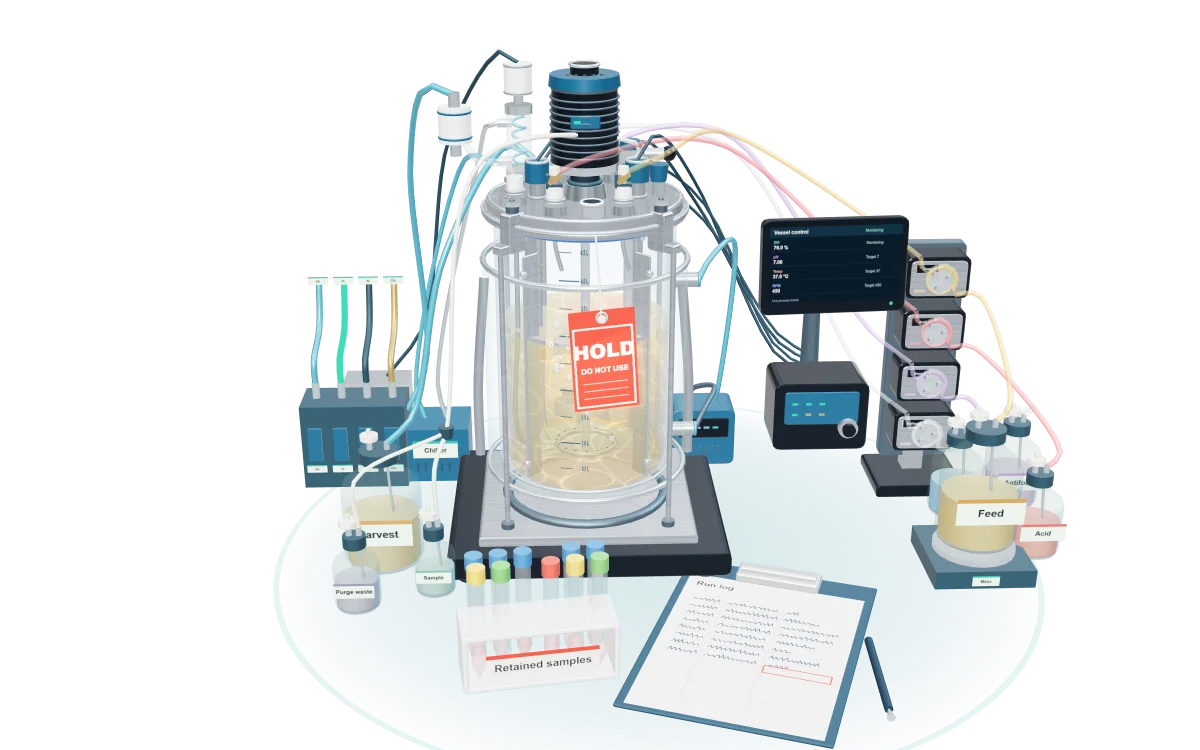
Keep the vessel closed, tag it, keep the samples with their identities and record the first abnormal observation and the last satisfactory check.
- Hold tag on the vessel
- Retained samples in a labelled rack
- Run log
- Headplate ports and clamps left closed
Quick check · 2 questions
Build a testable cause
Start the fishbone with a time-stamped observation. For example, pressure rose while the exhaust filter was wet. Check the heater status, drain and filter records for that interval, then test competing explanations. Distinguish a phone call or a repair order from evidence that the correction worked on a later run.
Quick check · 2 questions
Prepare the pre-run checks
Inspect the actual vent filter, heater, seals, septum and open or closed clamp positions for the current process stage. Verify calibration and the recorded pressure setpoint. At each future sampling event, account for both purge and sample. Use the checklist to record the finding, responsible person and follow-up before releasing equipment for use.
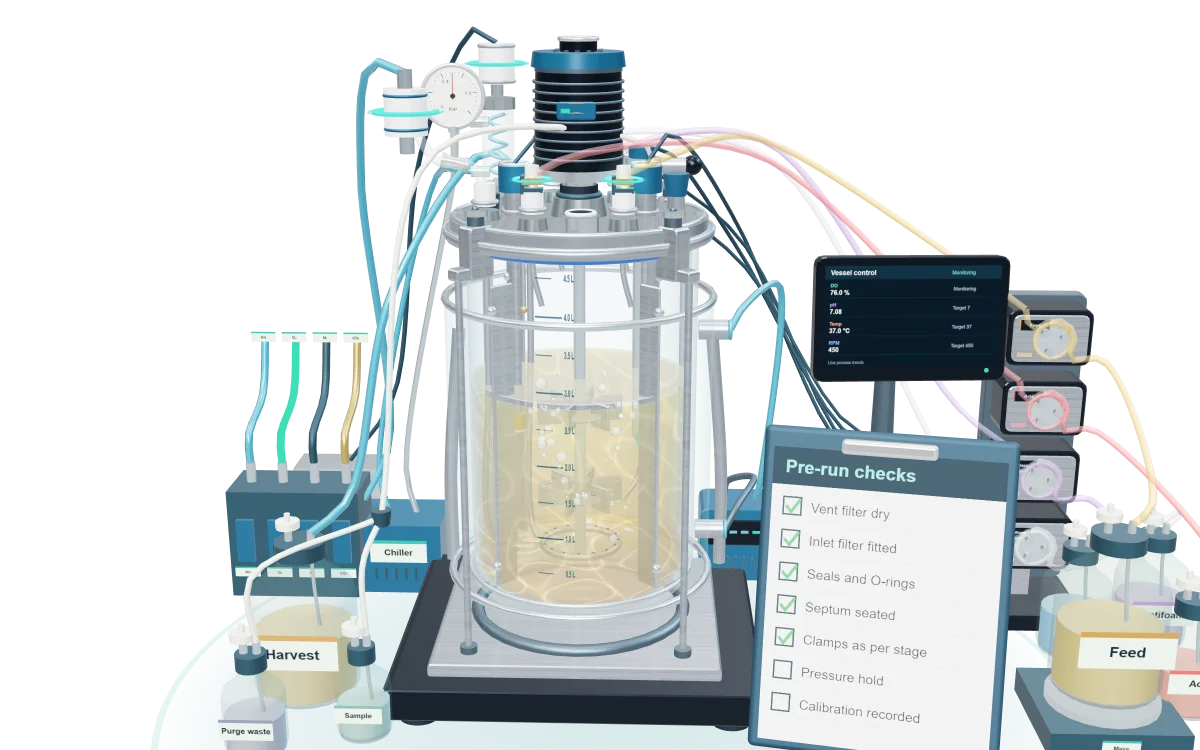
Before releasing the vessel, check the filters, seals and clamp positions for the current stage, confirm the pressure holds and record each finding.
- Pressure gauge teed into the gas inlet for the hold test
- Inlet gas filter in place
- Exhaust vent filter in place
- Line clamp closed for the hold test
- Pre-run checklist
Quick check · 2 questions
Interpret the cleanroom record
Read the location, particle size and room state before interpreting a particle count. Compare it with the classification table for the applicable state. Review environmental-monitoring trends separately. In an aseptic process simulation, sterile growth medium or another justified surrogate follows a representative run including interventions. Record the evidence each activity adds to the site’s contamination control strategy.
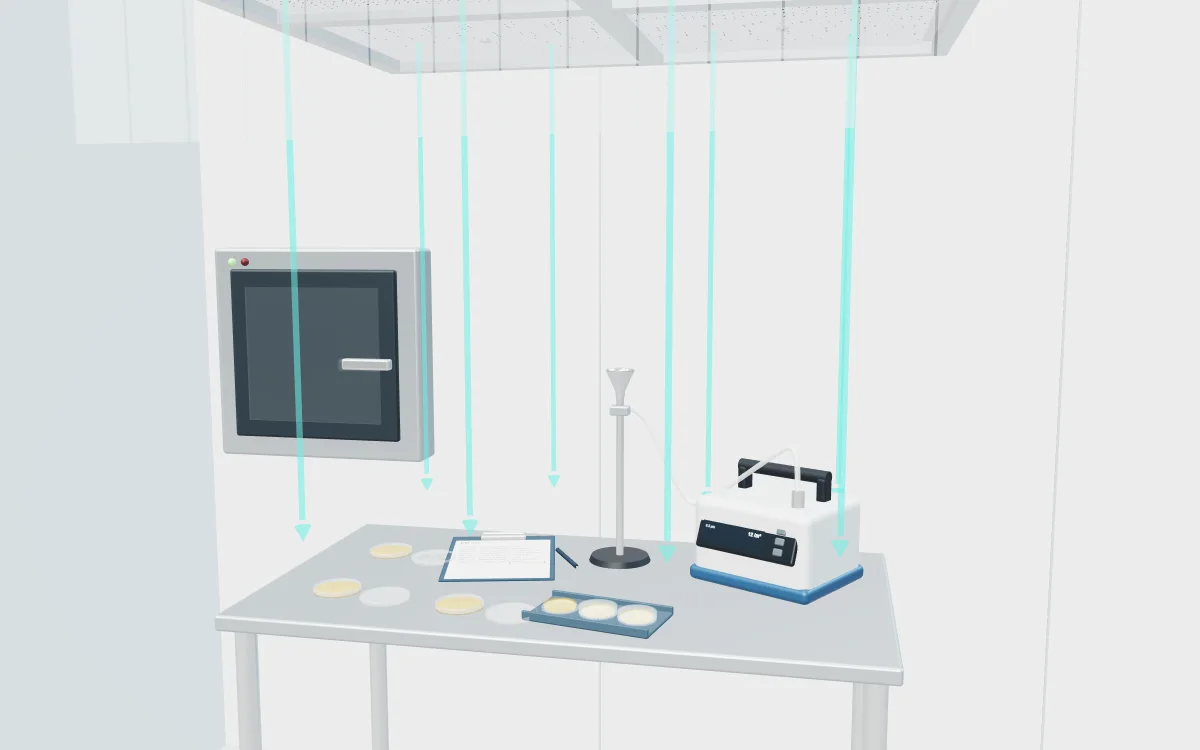
Settle and contact plates capture viable organisms, and the particle counter samples air through an isokinetic probe at work height. Read each result with its location, particle size and room state.
- HEPA terminal filter in the airflow canopy
- Open settle plate, lid upturned beside it
- Contact plate on its tray
- Portable particle counter
- Isokinetic sampling probe at work height
- Environmental monitoring log
Quick check · 2 questions
Practice and summary
Revisit your opening decision
CAPA · CCS · EM · APS · fishbone · five whys
Module flashcards
Confidence by objective
A low rating brings related cards forward for review.
Sources and further reading
Books
- P. Verma (ed.). Industrial Microbiology and Biotechnology: A New Horizon of the Microbial World. Springer Nature Singapore, 2024. Chapter 3, large-scale monoclonal antibody production and GMP.
- W. L. Hochfeld. Producing Biomolecular Substances with Fermenters, Bioreactors, and Biomolecular Synthesizers. CRC Press, 2006. Chapters 8 and 9, fermenters and bioreactors.
- Q. Li, C. Reeve, L. Martinez and S. Wright. “Scale-up in Biotechnology.” In M. Moo-Young (ed.), Comprehensive Biotechnology, 3rd ed., vol. 2. Elsevier, 2019. Chapter 2.62, microbiology quality control, pp. 921–923.
Guidance and background
- European Commission. EU GMP Annex 1, Manufacture of Sterile Medicinal Products (2022). Sections 2, 4, 8 and 9.
- ISO 14644-1:2015. Classification of air cleanliness by particle concentration.
Related BioProcess Tools pages
BioProcess Tools · Aseptic technique · Module 5
Response and prevention
Takeaways
- Hold affected work, preserve containment and notify the responsible team. Use approved procedures for evidence collection and disposition.
- Document samples, trends, interventions and equipment changes with their original times and identities.
- Use the fishbone to list testable hypotheses. Follow the evidence through the five whys to an actionable cause and an effectiveness check.
- A contamination control strategy connects design, materials, people, procedures and monitoring. Interpret room classification, viable monitoring and process simulation separately.
Check your understanding
- Contain a suspected deviation and preserve an interpretable record.
- Turn investigation evidence into a corrective action with an effectiveness check.
- Connect pre-run checks, monitoring and process simulation to a contamination control strategy.