Not a fermenter
A three-minute story with two challenges. Meet the vessel, then find the number that decides titre.
Read the transcript
This vessel is cut open so you can see inside it. Pink medium full of suspended CHO cells, one pitched-blade impeller, and a thin trail of bubbles from a microsparger. It looks like a fermenter. Almost every number attached to it is different.
Chinese hamster ovary cells are not fast, cheap or robust. They became the default host for therapeutic proteins for one reason. They make a protein a human body will accept. Two practical things followed. They were adapted to grow in suspension, so a process could be a stirred tank rather than an enormous number of flasks. And they were adapted to chemically defined medium with no serum, which removed a safety risk and an enormous source of batch-to-batch variability at the same time.
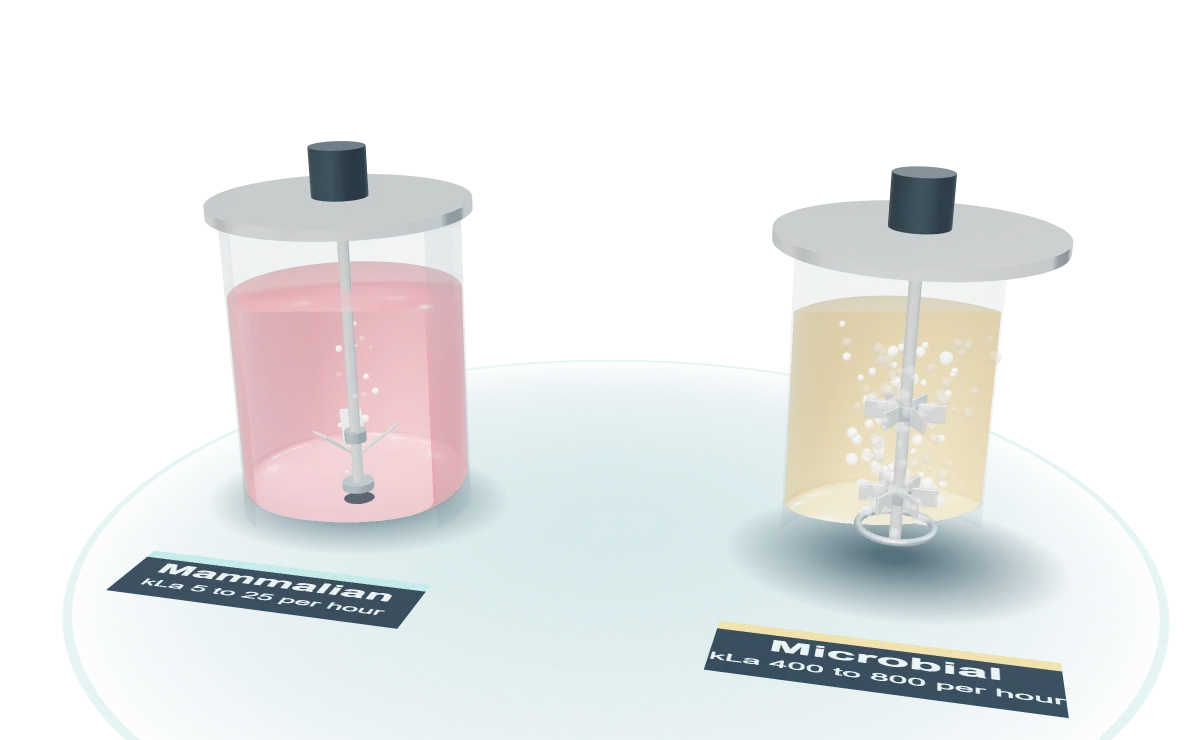
Now put the two machines side by side. Both of these vessels are cut toward you, drawn at the same scale. The mammalian tank is on the left, holding pink medium. A fermenter is on the right, holding amber broth.
On the left, one pitched-blade impeller turning gently, and a microsparger passing about a tenth of the gas rate.
On the right, two Rushton turbines, a ring sparger, and a dense bubble column filling the vessel. That column is what a fermenter needs, and it is what a mammalian culture cannot survive.
Your turn. Only one of these three belongs to the mammalian vessel on the left. Tap it. Challenge: Which of these belongs to the mammalian vessel? Answer: The single pitched-blade impeller (1) on the mammalian vessel.
Here is the pair of numbers that explains the whole course. A litre of CHO broth at 20 million cells per mL asks for about 6.6 mmol of oxygen an hour. That is roughly 30 times less than a dense fermentation.
Now look at supply, which is what that bubble column is for. A spinner flask transfers oxygen at 0.1 to 4 per hour, against a fermenter's 400 to 800. Even a production stirred tank for mammalian cells sits far closer to the first figure.
Quick judgement. You need about thirty times less oxygen than a fermentation, and you can supply something like forty times less of it. Are you better off or worse off? Challenge: Thirty times less demand, forty times less supply. Better or worse off? Options: Better off, because the demand is the easier number; Worse off, and oxygen is still a binding constraint; Neither, because the two cancel out. Answer: Worse off. Oxygen is still a binding constraint, and Module 5 is about that.
Everything in this course is an argument about one equation. A cell makes product at some rate per day. Multiply that by the cell days you accumulated, and you have how much product is in the tank. Specific productivity, times the integral of viable cell density.
One published comparison shows that working. The same molecule ran three ways and reached 22, 74 and 117 million cells per mL. Volumetric output differed roughly sixfold. Specific productivity was about 30 pg per cell per day in all three. Changing the mode changed how many cell days you could accumulate, and did not change what a cell does.
One caveat belongs with that sixfold figure. The fed-batch rate is a whole-run average, including the early days when there were hardly any cells. The perfusion rate is a steady-state one. The density ratio alone is about threefold, and Module 7 takes it apart properly.
So the vessel is not a fermenter, and the equation is where every later module reports back to. Now open the module below and run the contrast yourself.