Course overviewCourse progress
Module 01 of 08, free

The expression system

Four choices made at the bench decide most of what happens in the fermenter. None of them is free, and the strongest option is rarely the right one.

Module story ยท 3:13Watched

Four choices, one cell

A three-minute story with two challenges. Find the compartment that decides the project, then watch a population drift away from you.

Read the transcript

Four choices made at the bench decide most of what happens in this fermenter, drawn here cut open so the broth shows. None of them is free, and the strongest option is rarely the right one.

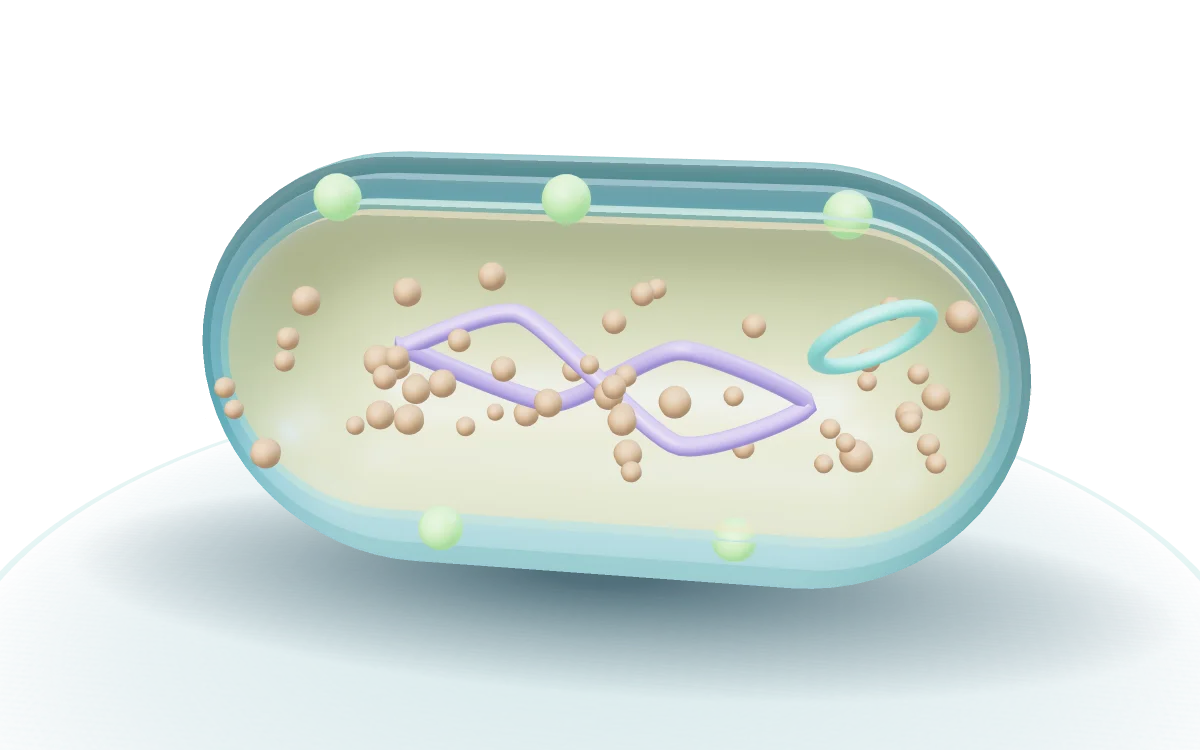
Start inside one cell. This one is cut open lengthwise, so both of its compartments show at once. The strain you pick is a chassis, and the compartment you make the protein in is part of that choice.

The cytoplasm is large, crowded and actively kept reducing. That is exactly wrong for a protein that needs disulphide bonds, because they will not form there.

The periplasm is a thin shell between the two membranes. It is already oxidising and it has folding catalysts in it. It is also small, so exporting there caps how much product you can accumulate.

The rest of the strain choice is a menu. Fewer proteases, so your product survives. A chromosomal copy of T7 polymerase, so a T7 promoter has something to read it. Extra transfer RNAs for rare codons. And the cassette rides on the plasmid, beside the chromosome.

Your turn. A protein needs two disulphide bonds. Tap the compartment where those bonds can actually form. Challenge: Where can disulphide bonds actually form? Answer: The periplasm (2), which is already oxidising.

Now the promoter on that plasmid. Promoters get compared on strength, which is the least interesting axis. The one that decides whether your run works is leakiness: how much product gets made before you asked for any.

A leaky promoter taxes the culture through the whole batch phase, and it hands a growth advantage to any cell that has quietly lost the plasmid. T7 is the strongest common choice and among the leakiest.

Carrying the plasmid is not free. It has to be replicated, transcribed and translated, and all three draw on the ribosomes, nucleotides and energy the cell would otherwise spend growing. The result is a lower growth rate and a lower yield on substrate.

The subtler cost is a population problem. Plasmids partition unevenly at division, so daughter cells inherit a spread of copy numbers. Cells carrying fewer copies bear less burden, so they grow faster, so they take a larger share at every generation.

A question. Productivity per cell falls steadily over a long seed train, although every individual cell behaves normally. What is the most likely explanation? Challenge: Productivity per cell falls over a long seed train, yet every cell behaves normally. Why? Options: The population has shifted towards cells carrying fewer plasmid copies; The strain has mutated, so each cell now makes less protein; A trace element the expression machinery needs has run out. Answer: The population shifted. Faster growers took a larger share every generation.

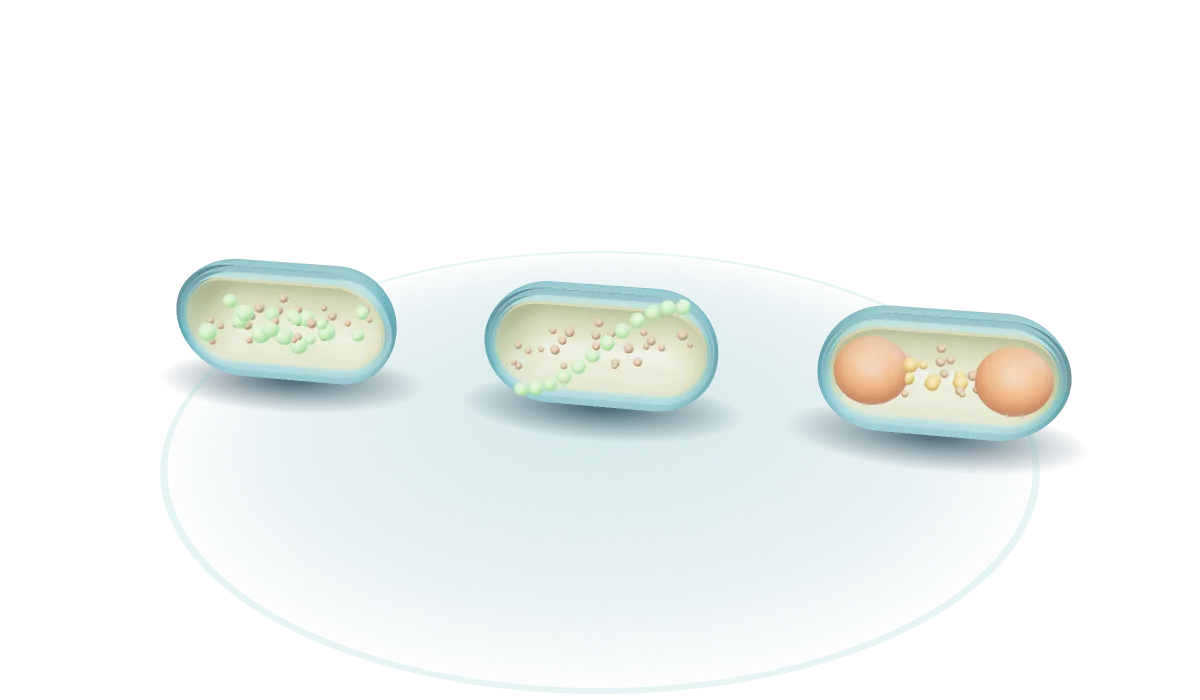
Here is the same construct with three outcomes, three cells cut open side by side. Soluble in the cytoplasm is what most people want. Exported to the periplasm buys the oxidising chemistry and costs capacity. Inclusion bodies are dense and misfolded, and you pay for them again at refolding.

So settle the compartment first, then pick the weakest promoter that still reaches your target, and count the generations before you commit to a long seed train. Now open the module below and make those four choices yourself.
You will be able to

  • Pick a host strain and say what it is good for.
  • Choose a promoter against leakiness as well as strength.
  • Account for metabolic burden and plasmid loss in a growth plan.
One-minute decision

In this module

Choose a host strain

E. coli is not one organism for this purpose. The strain you pick is a chassis with particular properties, and most production strains are variations on a few themes: fewer proteases so your product survives, a chromosomal copy of T7 polymerase so a T7 promoter has something to read it, extra transfer RNAs for codons E. coli uses rarely, or a modified cytoplasm that permits disulphide bonds.

A cutaway Escherichia coli cell lying on its side, opened lengthwise toward the viewer. Four nested layers are visible: an outer membrane, a thin blue periplasmic space, an inner membrane, and a large pale yellow cytoplasm filled with ribosomes, a looping purple nucleoid and a small teal plasmid ring. Green folded protein molecules sit in the periplasmic shell.
3D figureThe two compartments, and why the choice exists

The cell is cut open lengthwise so both compartments show at once. The cytoplasm is large, crowded and actively kept reducing, so disulphide bonds do not form there. The periplasm is a thin shell between the two membranes, already oxidising, with folding catalysts in it. That is the whole trade: capacity in one, chemistry in the other.

  1. Cytoplasm, reducing and crowded, with ribosomes throughout
  2. Periplasm, oxidising and thin, where disulphide bonds can form
  3. Plasmid carrying the expression cassette
  4. Nucleoid, the chromosome
  5. Outer membrane

The compartment matters more than people expect. The E. coli cytoplasm is actively kept reducing, which is exactly wrong for a protein that needs disulphide bonds. The periplasm is oxidising and has folding catalysts, but it is small, so exporting there caps how much product you can accumulate. That single fact decides a lot of projects before any fermentation question is asked.

What you are choosing between

Protease deficiency
Your product survives longer inside the cell. Standard in production strains.
T7 polymerase
Needed if you are using a T7 promoter. It transcribes several times faster than the host enzyme, which is both the attraction and the problem.
Rare codon supply
Extra transfer RNAs for codons common in your gene's original host and rare in E. coli. An alternative to recoding the gene.
Compartment
Cytoplasm is reducing and roomy. Periplasm is oxidising, has folding catalysts, and is small.

Choose a promoter

Promoters get compared on strength, which is the least interesting axis. The one that decides whether your run works is leakiness: how much product gets made before you asked for any. A leaky promoter taxes the culture through the whole batch phase, and worse, it hands a growth advantage to any cell that has quietly lost the plasmid.

T7 is the strongest common choice and among the leakiest, which is why the strains built to pair with it include ways of damping polymerase made before induction. If leakiness is your problem, a tightly repressed and dose-tunable promoter is usually a better answer than fighting a strong one.

The rule of thumb worth keeping

Choose the weakest promoter that still reaches your target. Strength you do not need is paid for in burden, in aggregation and in leakiness, and none of those is refundable later.

Account for metabolic burden

A plasmid is not free to carry. It has to be replicated, transcribed and translated, and every one of those draws on the same ribosomes, nucleotides and energy the cell would otherwise spend growing. The visible result is a lower growth rate and a lower yield on substrate than the same strain without the plasmid.

Three cutaway E. coli cells side by side at the same scale. The left cell has green folded product scattered through its cytoplasm. The middle cell has green product arranged around the thin periplasmic shell. The right cell has two large orange inclusion bodies, one at each pole, with a few loose amber chains between them.
3D figureThree places the product can end up

The same construct, three outcomes. Soluble in the cytoplasm is what most people want and the hardest to get at a high rate. Exported to the periplasm buys oxidising chemistry and costs capacity, because the compartment is small. Inclusion bodies are dense, misfolded and easy to purify, and you pay for them again at the refolding step.

  1. Soluble in the cytoplasm
  2. Exported to the periplasm
  3. Inclusion body at one pole
  4. Inclusion body at the other pole

The subtler result is a population problem. Plasmids partition unevenly at division, so daughter cells inherit a spread of copy numbers rather than an identical dose. Cells carrying fewer copies bear less burden, so they grow faster, so they make up a larger share of the population at every generation. Over enough generations a culture can drift towards cells that produce very little, which is why selection pressure is maintained and why a long seed train is a risk rather than a convenience.

The causal chain

Uneven partitioning
Division does not share plasmids equally between daughters.
Copy number spread
The population carries a distribution of copy numbers, not a single value.
Differential burden
Low-copy cells spend less on the construct and more on growing.
Population shift
Faster growers take a larger share each generation, so productivity falls even though nothing about any single cell has changed.

Source. Shuler ML and Varner JD, Cell Growth Dynamics, Comprehensive Biotechnology 3rd ed., Vol. 2, ch. 2.04, Elsevier 2019.

Practice and summary

Revisit your opening decision

Open module deck
Confidence by objective

A low rating brings related cards forward for review.

Sources and further reading

Books and chapters

  • Shuler ML, Varner JD. Cell Growth Dynamics. In: Moo-Young M, ed. Comprehensive Biotechnology, 3rd ed., Vol. 2, ch. 2.04. Elsevier, 2019. Plasmid partitioning, copy-number distribution and the population consequences of burden.
  • Promoter and strain properties in this module are drawn from the BioProcess Tools reference pages listed below rather than from the book library, which covers fermentation engineering rather than expression genetics.

Related BioProcess Tools pages

Next: growth and kinetics

The expression system