The one irreversible decision
A three-minute story with two challenges. See what a dose cannot buy, then find where a chain ends up when synthesis outruns folding.
Read the transcript
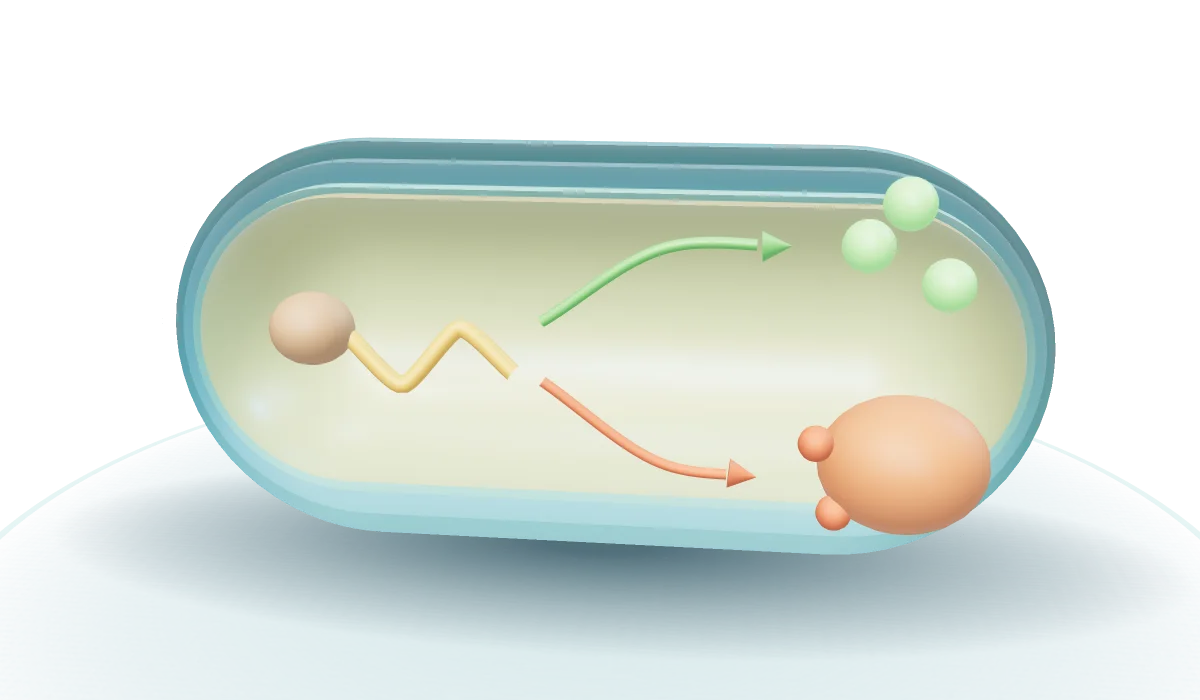
Switching expression on is the only irreversible decision in the run. This cell is cut open, and the ribosome on the left is already working.
Before induction the cells are building more cells. After it they are building your protein, more slowly, because the same ribosomes cannot do both. The run has a fixed length, so every hour spent growing is an hour not spent producing.
Induce early and a small population produces for a long time. Induce late and a large population produces briefly. The best point for total product is not the best point for soluble product, because a fast-growing cell makes protein faster than it can fold it.
The concrete figures are few. Mid-exponential induction for a BL21(DE3) culture, with a 16 to 24 hour induction phase after it. And expect the dissolved oxygen to need attention at the switch.
IPTG is the usual choice for lac-based promoters. It is not metabolised, so its concentration stays roughly constant and the switch is sharp and reproducible. It is also expensive at scale, and abrupt, which is what you do not want if your protein aggregates.
Lactose induces the same promoters and is consumed as it works, so the signal builds and fades rather than slamming on. In an auto-induction medium the culture grows on a preferred carbon source first and induces itself when that runs out.
A question. Published work found no difference in activity between 0.45 and 1 mM IPTG, a twofold range. What should you take from that? Challenge: No activity difference between 0.45 and 1 mM IPTG. What follows? Options: Dose is rarely the first lever worth adjusting; Always use the higher dose, since it cannot hurt; The assay must have been too insensitive to see a difference. Answer: Dose is rarely the lever. A twofold range gave the same activity.
A newly made chain has two futures. Folding runs at a roughly fixed speed set by the protein itself. Aggregation depends on how many unfolded chains are around at once, so it speeds up when synthesis does.
So the chain either reaches its native fold and stays soluble, or it finds another unfolded chain and ends up in an inclusion body. That is the whole mechanism, and it explains every lever that works.
Your turn. Tap where a chain ends up when synthesis outruns folding. Challenge: Where does a chain end up when synthesis outruns folding? Answer: Aggregated into an inclusion body (4).
Slow the synthesis down, with a weaker promoter or a smaller dose, and folding gets a larger share. Drop the temperature and both slow, but aggregation slows more. A solubilising fusion partner holds the chain soluble while it folds. None of this raises the total protein made.
Inclusion bodies are not automatically a failure. In the third of these three cut-open cells, they sit at the two poles: dense, nearly pure, easy to separate, and protected from proteases. What you must not do is end up in the middle, half aggregated with no refolding process ready.
If you do have them, it is a three-step problem. Get them out, unfold them completely with a chaotrope and, where there are cysteines, a reductant. Then refold at low protein concentration. Now choose an induction point yourself below.