Course overviewCourse progress
Module 07 of 08, Professional

Control and troubleshooting

The open-loop feed from Module 4 was a plan. This is what to do when the culture disagrees with it, and how to tell which of six failures you are looking at.

Module story ยท 3:22Watched

When the culture disagrees

A three-minute story with two challenges. See what a dissolved oxygen controller has to assume, then find the independent witness.

Read the transcript

The open-loop exponential feed from the last module assumed the growth rate and the yield stay where you put them. Neither does. Here is the vessel again, cut open, with its exhaust running off to the right.

Inoculum condition varies, the physiological state drifts, maintenance was never in the equation, and the feed carries on regardless of what the culture is actually doing. It cannot reject a disturbance because it cannot see one.

The recommended fix is the direct one. Determine the growth rate online and update the value used in the feed equation. That turns the plan into a feedback policy without changing the law at all, and it raised average biomass productivity in a published cultivation.

Four laws are on offer. Feed the exponential law with a measured growth rate, which assumes you can estimate biomass online. Add substrate when dissolved oxygen rises. Add it on a pH shift. Or run a PID controller on an error, in which case you cannot know the feed profile in advance.

Both stat strategies infer a cause from a symptom that has more than one cause. Dissolved oxygen rises when carbon runs out, and also when cells die, when a probe fails, and when foam breaks. A controller that responds by adding sugar is wrong in three of those four cases.

A question. A dissolved oxygen controller adds substrate whenever the oxygen trend rises. What is it assuming? Challenge: A DO-stat adds substrate when dissolved oxygen rises. What does it assume? Options: That nothing else can make dissolved oxygen rise; That the probe was calibrated before the run started; That the feed bottle is concentrated enough to last the phase. Answer: That nothing else can make dissolved oxygen rise.

Biomass, substrate and product are not measured online in a routine fermenter. That gap is why open-loop feeding survives. The exhaust leaves through a condenser and a filter, and a sample line carries it on to an analyser.

The analyser gives the oxygen uptake rate and the carbon dioxide evolution rate continuously, with nothing sampled and nothing sterile to break. Their ratio is the respiratory quotient, and it says what kind of metabolism is running.

Your turn. A probe in the broth and the exhaust disagree. Tap the one that is the independent witness. Challenge: Which reading is the independent witness? Answer: The analyser reading on the exhaust (3).

And that is the use that matters most. Nothing was opened into the vessel to get the reading. When a probe disagrees with the off-gas, the probe is usually the thing that is wrong.

If you want to close the loop on growth rate, you need biomass online. Capacitance responds only to cells with intact membranes, because only those polarise, so it reads viable biomass rather than total. Inline optical density is dominated by scattering and saturates at high density, just as the offline reading does.

Culture fluorescence is the useful negative result. It is linear only to about 2 g/L dry cell weight, which makes it useless for high cell density work, and one published table reports no correlation found for transformed E. coli specifically.

So close the loop on a measured growth rate where you can, treat a stat controller as an inference rather than a measurement, and let the exhaust arbitrate. Six failed runs are waiting below. Look for the decisive measurement, not the whole panel.
You will be able to

  • Close the loop on a feed, and say what each feedback law assumes.
  • Read oxygen uptake, carbon dioxide evolution and their ratio from the off-gas.
  • Diagnose a failed run from its traces and the cheapest decisive evidence.
One-minute decision

In this module

Close the loop on feeding

An open-loop exponential feed assumes the growth rate and the yield stay where you assumed they were. Neither does. Inoculum condition varies, the physiological state drifts, maintenance was never in the equation, and the feed carries on regardless of what the culture is actually doing. It cannot reject a disturbance because it cannot see one.

The recommended fix is the direct one: determine the growth rate online and update the value used in the feed equation. That turns the a priori profile into a feedback policy without changing the underlying law at all, and it raised average biomass productivity in a published cultivation.

The feedback laws and what each assumes

Estimated growth rate
Feed the exponential law with a measured mu rather than an assumed one. Assumes you can estimate biomass online, which is the hard part.
DO-stat
Add substrate when dissolved oxygen RISES, on the reasoning that a rise means the carbon has run out. Assumes nothing else can make oxygen rise.
pH-stat
Add substrate on a pH shift, since carbon exhaustion and by-product re-consumption both move pH characteristically. Assumes the pH signal is not being driven by something else.
PID on an error
F(t) = bias + Kc e + (Kc/tauI) integral(e dt) + Kc tauD de/dt. With an indirect parameterisation you cannot know the feed profile in advance; it depends on the deviations that actually occur.

Source. Ochoa S, Fed-Batch Fermentation: Design Strategies, Comprehensive Biotechnology 3rd ed., Vol. 2, ch. 2.41, Elsevier 2019.

Both stat strategies share a weakness worth stating plainly: they infer a cause from a symptom that has more than one cause. Dissolved oxygen rises when carbon runs out, and also when cells die, when a probe fails, and when foam breaks. A controller that responds by adding sugar will do the wrong thing in three of those four cases.

Read the off-gas

Biomass, substrate and product are not measured online in a routine fermenter. That gap is the reason open-loop feeding survives and the reason soft sensors exist. The off-gas is the cheapest partial answer to it: two analysers on the exhaust, nothing sampled, nothing to keep sterile, and a continuous read on what the culture is doing.

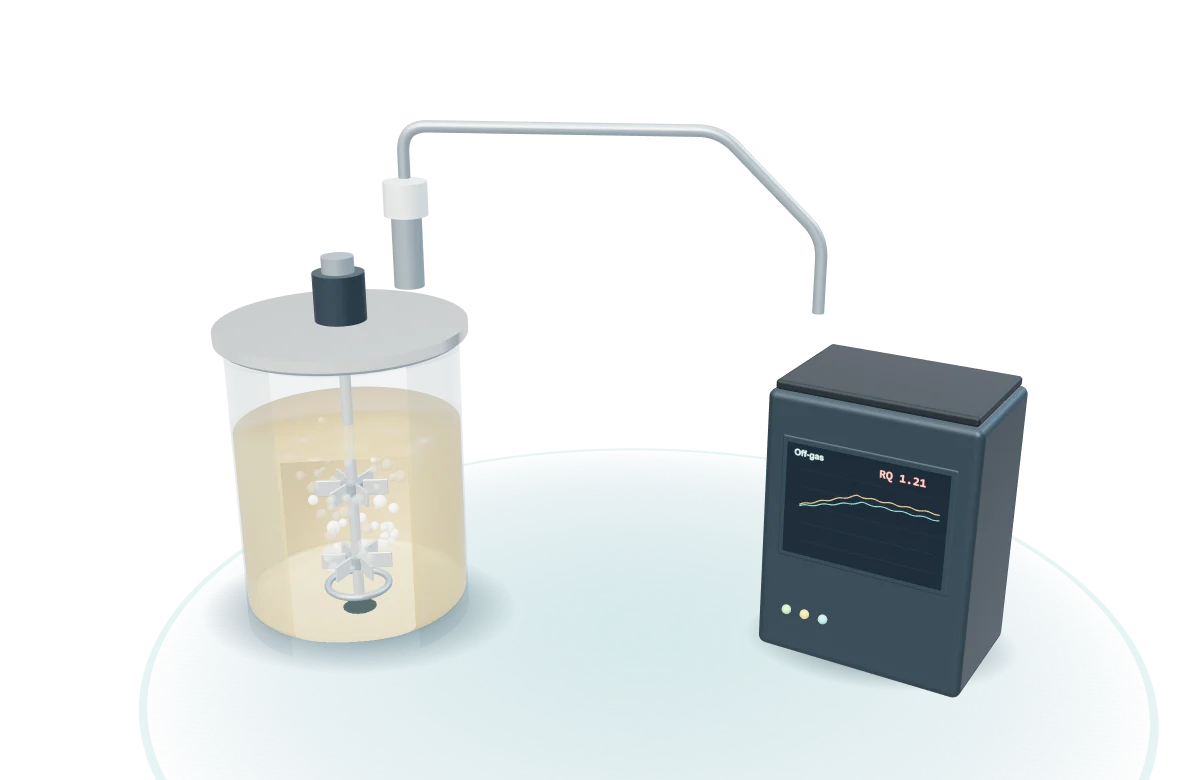
A cutaway bench fermenter at the left with its exhaust passing through a condenser and a filter, then a line curving across to an off-gas analyser at the right. The analyser screen plots two rising traces and reads RQ 1.21.
3D figureAn independent witness on the exhaust

An off-gas analyser on the exhaust gives the oxygen uptake and carbon dioxide evolution rates continuously, with nothing sampled and nothing sterile to break. Their ratio is the respiratory quotient, and it says what kind of metabolism is running. Near 1.0 is oxidative growth on glucose; 1.2 means a fermentative route is running alongside.

  1. Condenser and exhaust filter
  2. Sample line to the analyser
  3. Uptake and evolution rates, and their ratio
  4. The vessel, which the analyser never has to be opened into

What the ratio tells you

RQ near 1.0 is fully oxidative growth on glucose. RQ above about 1.1 means carbon dioxide is leaving faster than oxygen is arriving, which on glucose points at overflow and acetate. RQ below about 0.9 on glucose usually means a measurement or balance problem rather than biology.

And the use that matters most: the off-gas is an INDEPENDENT WITNESS. When a probe disagrees with it, the probe is usually the thing that is wrong.

What the biomass sensors can and cannot do

If you want to close the loop on growth rate, you need biomass online. Two common approaches, and one useful negative result.

Capacitance
Responds only to cells with intact membranes, because only those polarise. That makes it a VIABLE biomass measurement rather than a total one, which is usually what you want. Read as the difference between about 0.2 to 1 MHz and 10 MHz.
Optical density inline
Dominated by scattering, so it needs a calibration specific to the medium, and it suffers the same saturation at high density as the offline measurement.
Culture fluorescence
Linear only to about 2 g/L dry cell weight, which makes it useless for high cell density work. One published table reports NO correlation found for transformed E. coli specifically.

Source. Instrumentation and Analytical Methods, Comprehensive Biotechnology 3rd ed., Vol. 2, ch. 2.60, Elsevier 2019. That chapter does NOT cover off-gas analysis: its authors exclude process mass spectrometry from scope, so the balance relations in the previous section come from standard texts instead.

Diagnose a failed run

Six runs, each failing through a mechanism this course has already taught. Order evidence, name the cause, then name the root cause. Evidence costs time on purpose: the skill being practised is finding the decisive measurement, not ordering the whole panel.

Practice and summary

Revisit your opening decision

Open module deck
Confidence by objective

A low rating brings related cards forward for review.

Sources and further reading

Books and chapters

  • Ochoa S. Fed-Batch Fermentation: Design Strategies. Comprehensive Biotechnology, 3rd ed., Vol. 2, ch. 2.41. Elsevier, 2019. Open and closed loop strategies, the PID parameterisation and the online growth rate recommendation.
  • Instrumentation and Analytical Methods. Comprehensive Biotechnology, 3rd ed., Vol. 2, ch. 2.60. Elsevier, 2019. Capacitance, inline optical density and the culture fluorescence limits.
  • The oxygen and carbon dioxide balance relations are standard and are set out in a text such as Doran PM, Bioprocess Engineering Principles. Chapter 2.60 explicitly excludes process mass spectrometry, so they are not cited to it.

Related BioProcess Tools pages

Next: assessment

Control and troubleshooting