The flask was never going to
A three-minute story with two challenges. Find the filling volume that can actually move oxygen, then see why a longer seed train buys nothing.
Read the transcript
Design the medium backwards from the cells you want. Then find out why your shake flask was never going to get you there.
A complex medium made with extracts and hydrolysates grows cells quickly and cheaply, and you cannot say what is in it. A defined medium has every component specified. It usually grows cells more slowly, and it buys reproducibility between batches and a cleaner feedstock for purification.
If you know what a cell is made of, and how many grams per litre you want, the nitrogen and phosphorus follow directly. Carbon does not, because most of it leaves as carbon dioxide, so the yield coefficient sizes that part. Ammonium doubles as the pH titrant, so nitrogen and pH control are one lever.
A batch medium is not charged with all the glucose the run will need. Starting concentrations are kept to roughly 10 to 30 g/L, which is common practice rather than a measured limit, and the reason is acetate rather than osmolarity. Give the cells more sugar than they can respire and they make acetate with it.
A question. Why is the batch glucose capped instead of charged with everything the run needs? Challenge: Why cap the glucose in the batch medium? Options: Sugar the cells cannot respire comes back out as acetate; The osmolarity of the medium would stop the culture growing; Glucose caramelises if that much is sterilised in the vessel. Answer: Acetate. Sugar beyond what the cells can respire leaves as acetate.
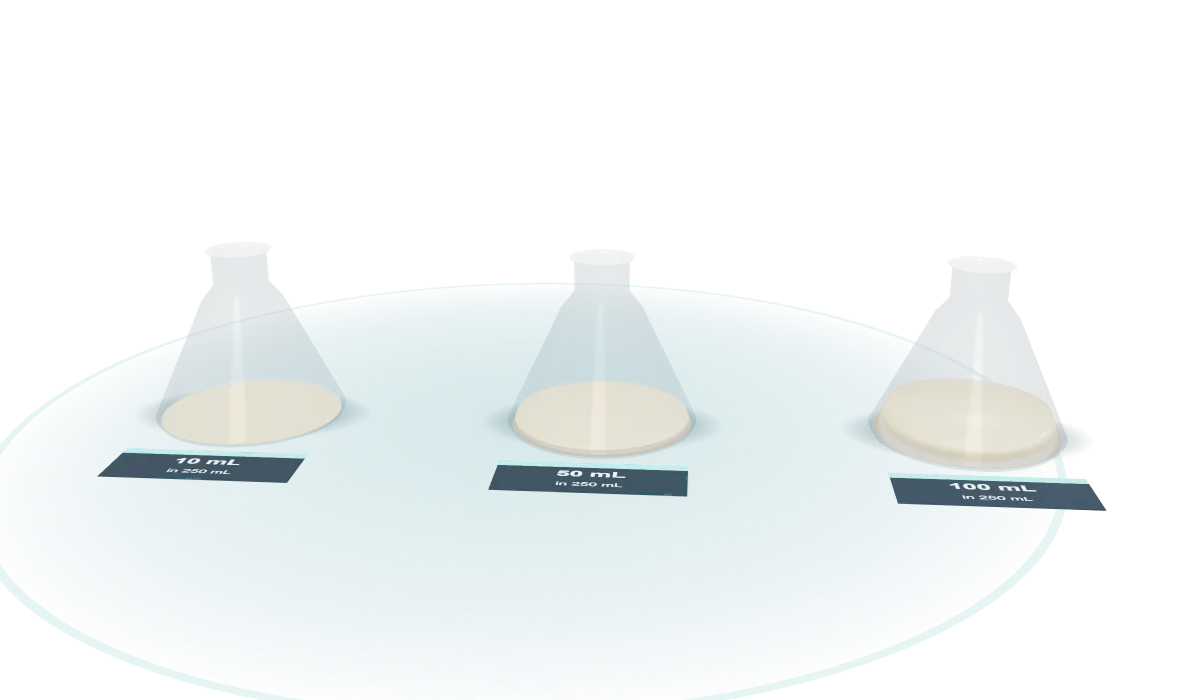
The most under-appreciated fact about shake flasks is how little oxygen they can move. A flask has no sparger. All the oxygen has to cross the surface of the liquid as it swirls. These are the same body three times over, holding 10, 50 and 100 mL.
For contrast, this vessel is cut open, and a ring sparger sits low in the broth. A flask has nothing of the kind. Its transfer depends on how much surface the shaking creates and how thin the film is, and filling it up destroys both.
Transfer scales roughly as the filling volume to the power of minus 0.83, so halving the volume nearly doubles the oxygen. The recommendation for aerobic E. coli is around 10 mL in a 250 mL flask, shaken hard.
Your turn. Tap the flask that can actually keep an aerobic culture growing exponentially. Challenge: Which filling volume can keep an aerobic culture growing exponentially? Answer: The 10 mL flask (1), about four per cent of nominal volume.
Three more levers sit behind it. Flask diameter is steeper still, at the power 1.92, but a flask of a given nominal volume cannot be widened much. Shaking frequency, to the power 1.16. And shaking diameter, the weakest of the four. Scaling a flask up at the same percentage fill loses you oxygen transfer, so flask results do not move between sizes for free.
One more thing a flask cannot do is hold pH. Holding pH to within 0.1 of setpoint gave a twofold increase in biomass, same medium, same flask. A flask is a screening tool and a seed vessel, not a small fermenter.
A seed train exists so the production vessel, cut open here, is started by enough healthy, actively growing cells. What the stage count does not change is the number of generations. That is fixed by how far you expand overall, from the vial to the production volume.
So if the selection pressure from the first module worries you, the lever is to start from a larger working cell bank or to finish in a smaller vessel. Rearranging the steps between those endpoints buys you nothing. Now plan a train yourself below.