Assessment and certificate
Read charts, solve transfer calculations and decide which evidence supports a scale-up decision.
You will be able to
- Select the appropriate quantity and unit basis for a scale calculation.
- Interpret measured trends and model assumptions.
- Justify a transfer conclusion using independent evidence.
Student assessment
Each attempt draws 15 questions, including fresh calculations. To earn the Student certificate, score at least 11/15 and pass one scored section check in each of Modules 1–6. You can finish outstanding checks after the assessment.
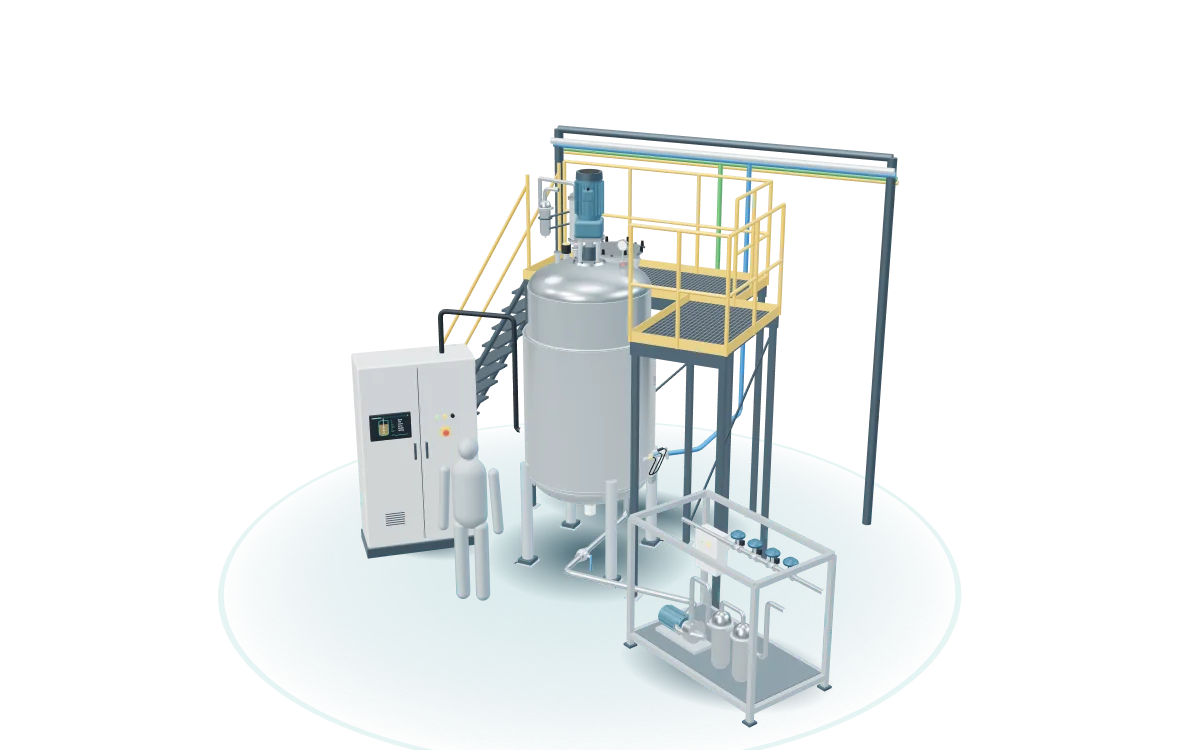
The vessel is only part of the system being scaled. Its access platform, gas and coolant utilities, process skid and control cabinet all set limits on a transfer, and the assessment draws on each of them.
- 2,000 L production vessel
- Access platform with stairs and handrails
- Process skid with pump and filter housings
- Control cabinet with operator screen
- Transfer line from the bottom outlet to the skid
Quick check · 2 questions
Professional case assessment
Analyse ten questions drawn from seeded transfer cases. The Professional certificate requires the Student requirements, a score of at least 7/10 on this assessment, and one passed scored section check in Module 7. Your typed name and printout stay in this browser.
Quick check · 2 questions
Practice and summary
Revisit your opening decision
working volume · DO · kLa · cooling margin · model qualification
Module flashcards
Professional flashcards
Open Professional deck
Confidence by objective
A low rating brings related cards forward for review.
Sources and further reading
Books and chapters
- K. van’t Riet and R. G. J. M. van der Lans. “Mixing in Bioreactor Vessels.” In M. Moo-Young (ed.), Comprehensive Biotechnology, 3rd ed., vol. 2. Elsevier, 2019. Chapter 2.08.
- M. Müller. “Heat Transfer in Bioreactors.” In M. Moo-Young (ed.), Comprehensive Biotechnology, 3rd ed., vol. 2. Elsevier, 2019. Chapter 2.12.
- Q. Li, C. Reeve, L. Martinez and S. Wright. “Scale-up in Biotechnology.” In M. Moo-Young (ed.), Comprehensive Biotechnology, 3rd ed., vol. 2. Elsevier, 2019. Chapter 2.62.
- R. Pörtner (ed.). Biopharmaceutical Manufacturing: Progress, Trends and Challenges. Springer, 2023. Chapters 1 and 3, single-use systems and industrial cell-culture reactor characterisation.
- R. Pörtner and J. Möller (eds.). Bioprocess Systems Engineering Applications in Pharmaceutical Manufacturing. MDPI, 2022. Contributions by F. Freiberger et al. on local hydrodynamics and T. Hernández Rodríguez et al. on seed-train design.
- B. Ponce and colleagues. Chapter 18, alginate production at different scales. In S. P. Singh and S. K. Upadhyay (eds.), Microbial Bioreactors for Industrial Molecules. Wiley, 2023. Table 18.4.
Papers and guidance
- K. van’t Riet (1979). Review of measuring methods and results in nonviscous gas–liquid mass transfer in stirred vessels.
- ICH Q5E. Comparability of biotechnological/biological products subject to changes in their manufacturing process.
- D. J. Schuirmann (1987). The two one-sided tests procedure for assessing equivalence.
Related BioProcess Tools pages
BioProcess Tools · Scale-up and scale-down · Module 8
Assessment and certificate
Takeaways
- Write the comparison on one unit, reference-condition and working-volume basis.
- Keep calculated estimates, illustrative assumptions and observed data distinguishable in the handover.
- Check mixing, transfer and heat margins against the relevant demand. State where the measurement was taken.
- Link each conclusion to the attribute it supports and identify any independent check still needed.
Check your understanding
- Select the appropriate quantity and unit basis for a scale calculation.
- Interpret measured trends and model assumptions.
- Justify a transfer conclusion using independent evidence.