Similarity and scale-up criteria
Choose what to keep constant and see what that choice costs in pumping, mixing, power and tip speed.
You will be able to
- Relate changes in linear dimensions to changes in volume.
- Choose a speed rule and predict its trade-offs.
- Recognise the assumptions behind a similarity table.
Hold one quantity constant
Use working liquid height H, tank diameter T and impeller diameter D to define the geometry. With an unchanged fluid, impeller and turbulent regime, the same H/T and D/T make scale ratios interpretable. The Reynolds number compares inertia with viscosity, the power number describes shaft power, and the Froude number compares rotational inertia with gravity. Their responses to a scale change differ.
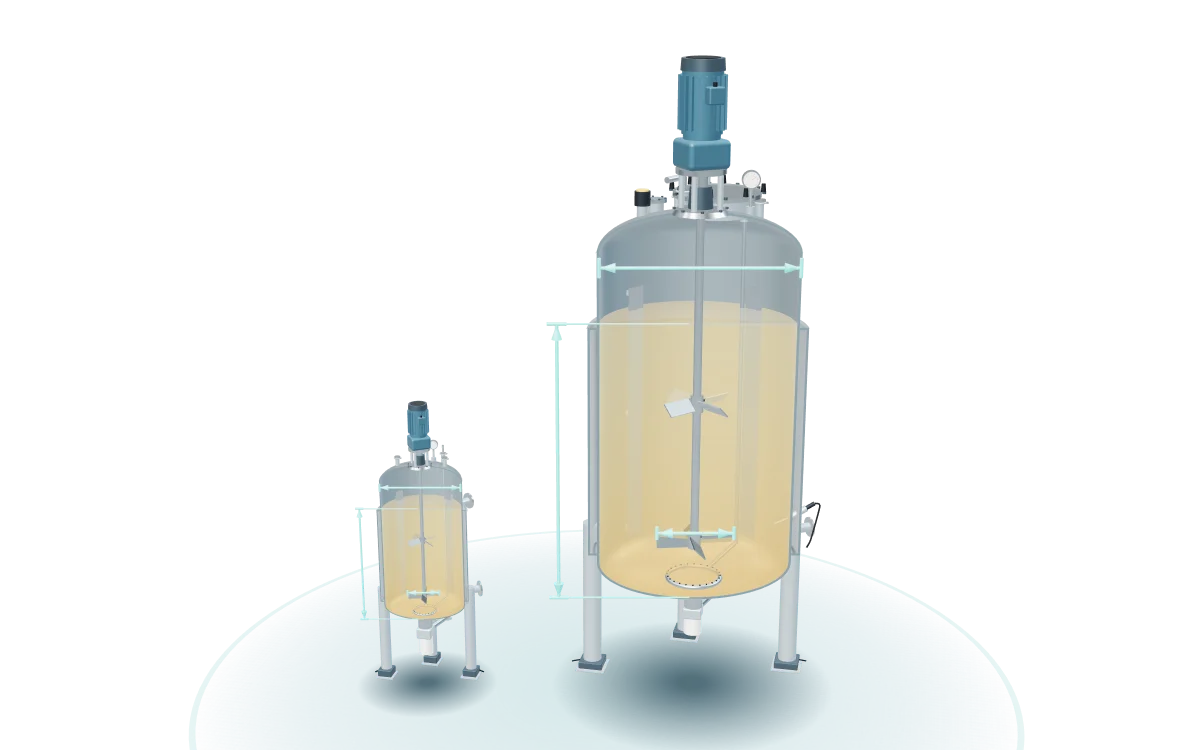
Two stirred tanks with the same H/T and D/T ratios. Holding the shape fixed makes scale ratios interpretable, but volume still grows with the cube of the diameter ratio and wall area with its square.
- Tank diameter T
- Working liquid height H
- Impeller diameter D
- The small tank keeps the same H/T and D/T
Quick check · 2 questions
Choose the transfer criterion
A process objective gives a criterion its meaning. A polymer process may need to preserve molecular weight as well as titre. A speed that preserves mean power per volume changes the tip speed and circulation time. Work through the same transfer under three different constraints and decide which additional measurement would test your choice.

Two Rushton turbines with a diameter ratio of 2, drawn for constant power per volume. The larger impeller turns at about 0.63 times the speed, yet its blade tips move about 1.26 times faster.
- Swept volume of the blades
- Shaft speed of the small impeller
- Tip speed of the small impeller
- Shaft speed of the large impeller, about 0.63 times
- Tip speed of the large impeller, about 1.26 times
Quick check · 2 questions
Review ten transfer proposals
Practice and summary
Revisit your opening decision
linear scale factor · power number · tip speed · Reynolds number · Froude number
Module flashcards
Confidence by objective
A low rating brings related cards forward for review.
Sources and further reading
Books and chapters
- Q. Li, C. Reeve, L. Martinez and S. Wright. “Scale-up in Biotechnology.” In M. Moo-Young (ed.), Comprehensive Biotechnology, 3rd ed., vol. 2. Elsevier, 2019. Chapter 2.62.
- K. van’t Riet and R. G. J. M. van der Lans. “Mixing in Bioreactor Vessels.” In M. Moo-Young (ed.), Comprehensive Biotechnology, 3rd ed., vol. 2. Elsevier, 2019. Chapter 2.08.
- B. Ponce and colleagues. Chapter 18, alginate production at different scales. In S. P. Singh and S. K. Upadhyay (eds.), Microbial Bioreactors for Industrial Molecules. Wiley, 2023. Table 18.4.
- C.-F. Mandenius (ed.). Bioreactors: Design, Operation and Novel Applications. Wiley-VCH, 2016, chs. 9 and 11. R. Pörtner (ed.), Biopharmaceutical Manufacturing: Progress, Trends and Challenges. Springer, 2023, ch. 1.
Papers and guidance
Related BioProcess Tools pages
BioProcess Tools · Scale-up and scale-down · Module 2
Similarity and scale-up criteria
Takeaways
- Define the linear factor from the cube root of the working-volume ratio under geometric similarity.
- For a fixed turbulent power number and density, P/V varies as N³D². Tip speed varies as ND.
- Matching Re constrains viscous similarity. Fr compares inertial with gravitational effects.
- A kLa target requires a gas-flow basis and an applicable correlation. Verify it experimentally.
Check your understanding
- Relate changes in linear dimensions to changes in volume.
- Choose a speed rule and predict its trade-offs.
- Recognise the assumptions behind a similarity table.