Off-gas and oxygen transfer
Close a gas balance, estimate oxygen demand and fit a transfer coefficient from a re-aeration curve.
You will be able to
- Fit a cell-free oxygen recovery curve.
- Reconstruct dry gas flows and interpret RQ.
- Compare oxygen demand with the transfer ceiling.
Gassing-out lab
In cell-free liquid, strip oxygen with nitrogen to below 10% of air saturation. Switch to air with the same mixing and gas flow. Start the fit after residual nitrogen bubbles leave. At constant C* in each phase, the mass balance is dC/dt = kLa(C* − C). In this simulation, C* is 0% during nitrogen stripping and 100% during air re-aeration. Both phases use 0.80 vvm and kLa = 8.32 h⁻¹. The gas switches at minute 20, when liquid DO is about 6.2%.
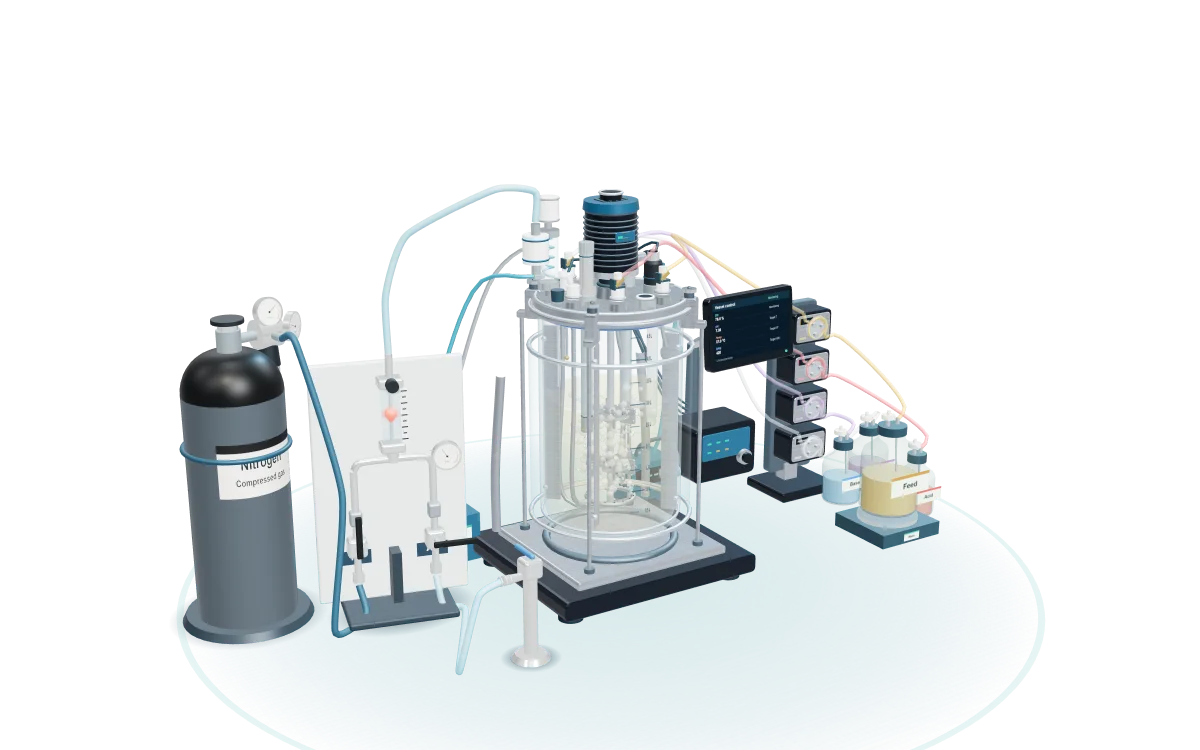
Strip oxygen from cell-free medium with nitrogen, then switch the manifold to air at the same gas flow and mixing. The DO probe records the re-aeration curve used to fit kLa.
- Nitrogen cylinder and regulator
- Air supply tap
- Switching valves on the gas manifold
- Rotameter holding the same gas flow
- Bubbles rising from the sparger
- Optical dissolved oxygen probe head
Fit 20% to 80% of the air-saturation reading as a starting window. Early points can contain switch and probe lag. Late points magnify errors in C*. Measure C* in the actual medium at operating conditions. For the pre-calibrated procedure in the assessment, establish C* with air before stripping. Another valid method takes C* from a stable final re-aeration plateau. The probe time constant must be short compared with 1/kLa. In cells, add an uptake term or use a method that accounts for it.
Quick check · 2 questions
Read the exhaust
Paramagnetic or electrochemical instruments can measure exhaust O₂. Non-dispersive infrared absorption is common for CO₂. Dry the sample or correct for water vapour. Match inlet and outlet pressure, flow basis and timestamps. A dissolved CO₂ probe measures something different: in a Severinghaus design, CO₂ crosses a membrane and changes the pH of an internal bicarbonate electrolyte.
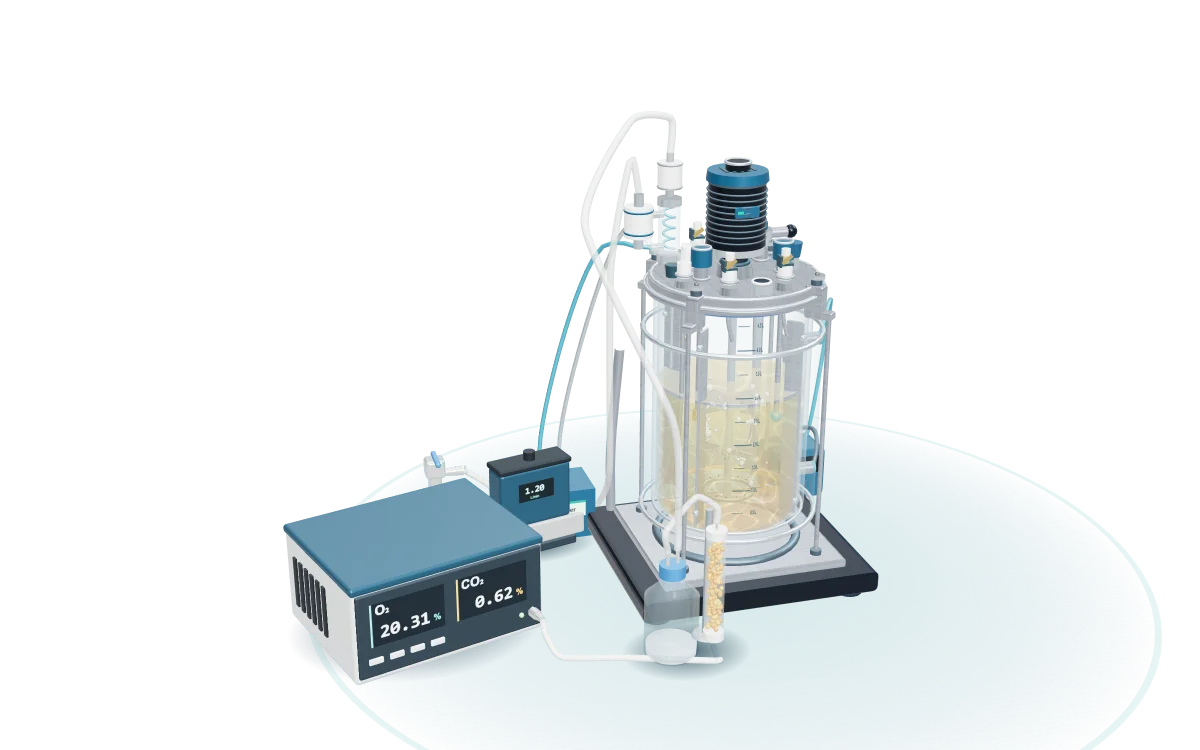
A mass flow controller sets the inlet flow. Exhaust leaves through the condenser and filter, is dried, and the analyser reads oxygen and carbon dioxide.
- Mass flow controller on the inlet
- Exhaust condenser
- Exhaust filter
- Condensate trap and drying column
- Exhaust O₂ readout
- Exhaust CO₂ readout
For a steady gas inventory and approximately equal inlet and outlet molar flows, subtract outlet oxygen from inlet oxygen; reverse the subtraction for carbon dioxide. Whole-reactor rates have units of mol/h. Divide by liquid volume for volumetric rates. Gas exchange approximates cellular OUR and CER only when accumulation and other sources or sinks are negligible.
CER and CPR denote carbon dioxide evolution and production. Dissolved CO₂ storage, buffering and stripping can separate them transiently. RQ near 1 is consistent with complete glucose oxidation. In Crabtree-positive yeast, a rise can indicate overflow to ethanol even when oxygen is available. Check feed, DO and an independent ethanol or substrate result.
Use the dry inert-gas balance
Dry inlet and exhaust flows can differ. Let yI be the mole fraction of conserved inert gas, typically nitrogen plus argon. When the other dry components are O₂ and CO₂, yI = 1 − yO₂ − yCO₂. At steady gas inventory, with no leaks, inert accumulation or uptake, Fin yI,in = Fout yI,out.
OUR = Fin yO₂,in − Fout yO₂,out
CER = Fout yCO₂,out − Fin yCO₂,in
Use 20.95% O₂ and 0.04% CO₂ for dry air throughout this course. With oxygen enrichment, the inlet fraction and total flow can both change, so use the actual blended supply. For the dry-air example below, compare the equal-flow estimate with the inert-corrected result.
Quick check · 3 questions
When oxygen supply sets the ceiling
C* is the equilibrium dissolved oxygen concentration for the actual gas mixture and pressure. C is the broth concentration. At steady DO, OTR balances OUR on the same volume basis. If demand exceeds the transfer ceiling, dissolved oxygen falls and actual uptake can become transfer-limited.
| Method | What can bias the result |
|---|---|
| Dynamic re-aeration | Probe lag, changing C*, living-cell uptake or a long gas-switch transient. |
| Sulphite oxidation | A chemical oxygen sink can hold C near zero. Salt and catalyst change medium properties. A sulphite result needs verification in the process broth. |
| Gas balance | Use inlet and outlet oxygen flow and a representative dissolved concentration. At quasi-steady state kLa = OUR/(C* − C). A small concentration difference amplifies noise. |
A correlation may omit viscosity, biomass, coalescence or vessel internals. Different single-use systems can operate at very different kLa values. Measure transfer under the mixing, gas and medium conditions that matter.
Quick check · 2 questions
Oxygen enrichment and RQ decisions
During an oxygen cascade, reconstruct the mixed inlet from the dry molar flows and gas fractions of all supply lines. Use this blended composition and the measured exhaust composition in the inert-gas balance. Align the inlet change with the analyser delay. During a rapid gas switch, allow for headspace accumulation before interpreting RQ.
A small inlet-to-outlet O₂ difference can approach the analyser uncertainty in a mammalian process. Use the calculator to compare a dry-air run with an oxygen-enriched run. Then use the worked example to decide how much the dry-air RQ changes as the exhaust composition shifts.
Quick check · 2 questions
From exhaust to biomass and feed
Here X is total biomass in grams. The growth-associated yield α has units g CO₂/g biomass. The maintenance coefficient β has units g CO₂/(g biomass·h). If μ is known, X = CPR/(αμ + β). With X known, invert the same balance to estimate μ. One rate alone cannot identify both X and μ.
Cumulative CO₂ control
Integrate the measured molar CO₂ production after correcting the baseline and delay. A calibrated yield maps cumulative CO₂ to biomass growth. A controller can follow a target exponential trajectory by adjusting feed within pump limits. Maintenance, a change of substrate or a CO₂ leak cause the integral to drift. Reconcile it with independent biomass samples. Freeze feedback and use a qualified fallback if the residual is sustained.
Quick check · 2 questions
Sources and further reading
- D. Caşcaval, “Oxygen Mass Transfer in Bioreactors”, Comprehensive Biotechnology, 3rd ed., edited by M. Moo-Young, Elsevier, 2019, ch. 2.11.
- R. Pörtner (ed.), Biopharmaceutical Manufacturing: Progress, Trends and Challenges, Springer, 2024 print edition, ch. 3 on characterisation of industrial bioreactors.
- C. Herwig, R. Pörtner and J. Möller (eds.), Digital Twins: Applications to the Design and Optimization of Bioprocesses, Springer, 2021, ch. 3, Appl et al., on developing control strategies.
Review and apply
Revisit the opening decision
Module flashcards
Professional review cards
Confidence by objective
Choose low to bring the related cards forward for review.
BioProcess Tools · Module summary
Off-gas and oxygen transfer
Key relationships
- OTR = kLa(C* − C). At C = 0, OTRmax = kLa C*.
- Fout = Fin yI,in/yI,out. RQ = CER/OUR on a molar basis.
Faults and checks
| Observation | Interpretation or check |
|---|---|
| Curved log fit | Inspect switch delay, probe lag and the final plateau. |
| RQ spike after gas switch | Align analyser delay and assess accumulation. |
Numbers to remember
- Dry air basis here is 20.95% O₂ and 0.04% CO₂.
- 1 h = 3600 s. Both rates in a ratio need the same time basis.