PAT, QbD and data integrity
Choose a monitoring strategy and trace a quality decision back to its measurements and model version.
You will be able to
- Test parameter interactions against a quality response.
- Reconstruct a measurement and flag defects in its audit trail.
- Choose a quality-linked monitoring and fallback strategy.
Design the measurement around product quality
The FDA’s 2004 PAT framework encourages timely measurement and process understanding. A useful PAT deployment may shorten cycles, reduce rejected batches, support real-time release, automate decisions, reduce material or energy use, or enable continuous processing. Real-time release needs a justified and accepted control strategy.
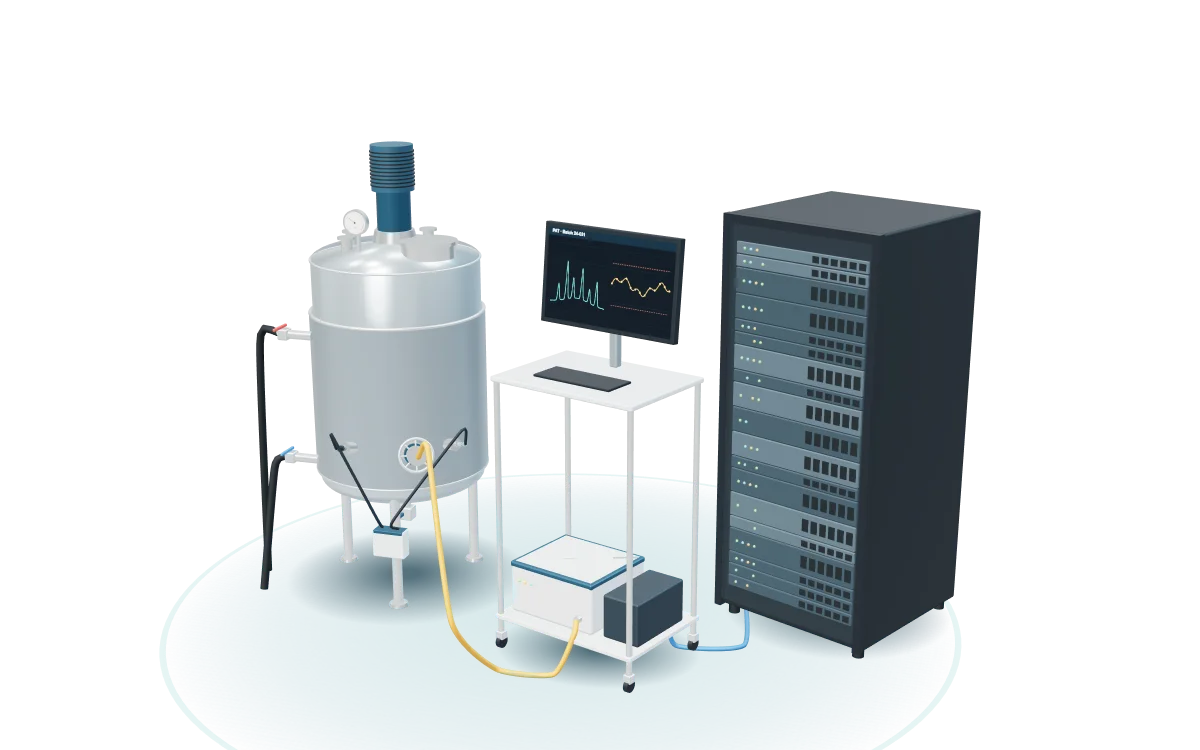
An in-line spectroscopic probe feeds a PAT analyser that predicts a quality attribute in real time. The data are stored with the batch record for review.
- In-line spectroscopic probe in a retractable housing on a side port
- PAT analyser
- Spectrum and predicted attribute against limits
- Data line
- Server storing the time-aligned data
| QbD term | Example in a control strategy |
|---|---|
| Critical quality attribute (CQA) | A property whose acceptable range protects quality, such as the glycan distribution of an antibody. |
| Critical process parameter (CPP) | A parameter whose variability affects a CQA and therefore requires monitoring or control. Establish the link experimentally; a logged parameter is not automatically critical. |
| Design space | An evidence-backed multidimensional combination of inputs and parameters that assures quality. Under ICH Q8, working within an approved design space is not considered a regulatory change. |
| PAR and NOR | A proven acceptable range (PAR) demonstrates acceptable performance over a parameter interval under specified conditions. A normal operating range (NOR) is the routine target range. Separate acceptable ranges alone do not establish interactions or an approved design space. |
On a range excursion, retain the data, assess duration and impact, and follow the approved investigation and disposition procedure. Define the measurement, action limit, owner, response and verification in the control strategy.
Quick check · 2 questions
Maintain a defensible sensor record
ALCOA+ describes records that are attributable, legible, contemporaneous, original and accurate, as well as complete, consistent, enduring and available. For a pH correction, preserve the raw millivolts, temperature, calibration version, resulting pH, operator and timestamp. Retrospective smoothing should create a traceable derived series.
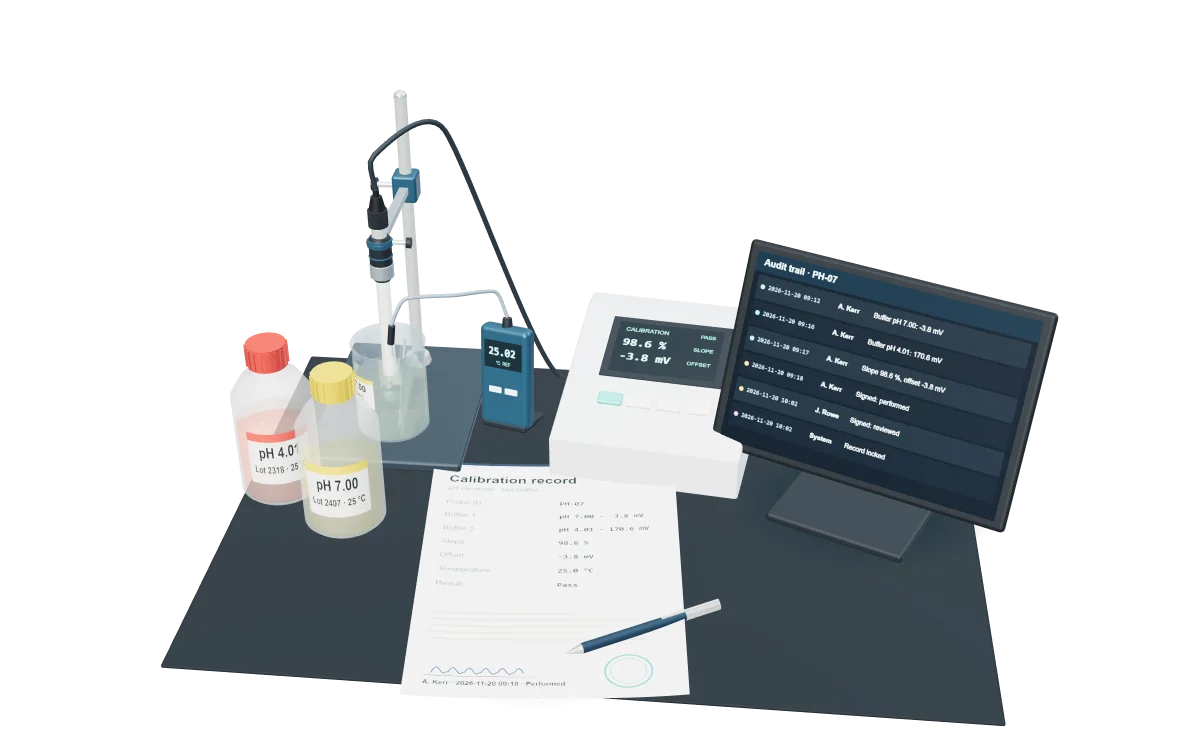
Calibrate against fresh buffers with a reference thermometer in the same beaker. The printed record keeps the raw values, the result and the signatures, and the electronic audit trail shows who did what, and when.
- Probe on the calibration stand in buffer
- Reference thermometer
- Buffer stock bottles with lot labels
- Meter showing slope and offset
- Printed record, signed with its meaning
- Time-stamped audit trail
For electronic records subject to FDA predicate rules, evaluate 21 CFR Part 11 scope. Controls for closed systems include system validation, access limits, record protection and time-stamped audit trails. Section 11.10 addresses controls for closed systems. For a signed record, § 11.50 specifies the signer’s printed name, date and time, and meaning of the signature. Section 11.70 requires a link that prevents the signature from being transferred by ordinary means to falsify another record. Configure review of relevant audit trails and preserve prior values. Software purchase alone cannot establish fitness for an intended use.
A historian time-aligns signals, events, calibrations, units and quality flags. Retain gap markers and the clock source. Continued process verification uses these records to trend variability and detect changes across commercial batches. A historian is a practical implementation choice. The programme also needs ownership, review and documented responses.
Make model output reconstructible
Store the input snapshot, model version, preprocessing, output, uncertainty, operator override and action. Explain which signals supported the decision. Define drift triggers, rollback and revalidation after change under the pharmaceutical quality system.
Quick check · 2 questions
Two monitoring strategy decisions
E. coli fed-batch process development
A development team sees a DO rise after feed changes. It needs to distinguish carbon depletion from a gas-flow change. Use pH, DO, temperature, feed-bottle mass and dry off-gas. Align pump events with analyser delay. Confirm with occasional substrate and dry-weight samples. Estimate OUR/RQ only while the gas balance closes.
A useful first investment is a balance if pump delivery varies. It tests what actually reached the vessel. Add a biomass estimator only if the improvement in decision time outweighs calibration and maintenance. Track false intervention rate on later batches.
CHO GMP manufacturing
A glucose estimate would adjust feed on a line with a glycosylation CQA. Establish the link between glucose exposure, feed change and product quality. Use qualified pH and DO instruments, reference assays and a calibrated feed balance. Evaluate Raman or capacitance in parallel with the approved workflow.
Challenge new raw-material lots, clones, low glucose and sensor replacement across independent batches. Specify alarms, fallback to at-line checks and approved limits on feed changes. Budget for reference assays, calibration transfer, version control, training and periodic verification. Compare this recurring cost with the reduction in delayed decisions and deviation investigations.
Quick check · 2 questions
Sources and further reading
- R. Pörtner (ed.), Biopharmaceutical Manufacturing: Progress, Trends and Challenges, Springer, 2024 print edition, chs. 6, 9 and 11 on digital twins, quality by design and digital manufacturing.
- C. Herwig, R. Pörtner and J. Möller (eds.), Digital Twins: Applications to the Design and Optimization of Bioprocesses, Springer, 2021, ch. 1 on PAT and scale-down, and ch. 3 on control strategy.
Primary guidance and regulation
Review and apply
Revisit the opening decision
Module flashcards
Confidence by objective
Choose low to bring the related cards forward for review.
BioProcess Tools · Module summary
PAT, QbD and data integrity
Key relationships
- A reported pH must be recoverable from raw mV, temperature and the calibration active at measurement.
- Separate one-variable PARs do not define a multidimensional design space.
Faults and checks
| Observation | Interpretation or check |
|---|---|
| Prior value disappears | Retrieve the original and a time-linked change record. |
| Unexplained historian gap | Check clock source, missing records and event sequence. |
| Quality model moved to a new lot | Challenge it on independent representative batches. |
Numbers to remember
- The record exercise has eight historian rows.
- A signed record retains the identity, time, meaning and linkage of the signature.