Nothing ever leaves
A three-minute story with two challenges. Walk up the osmolality staircase, then find the lever that actually lowers it.
Read the transcript
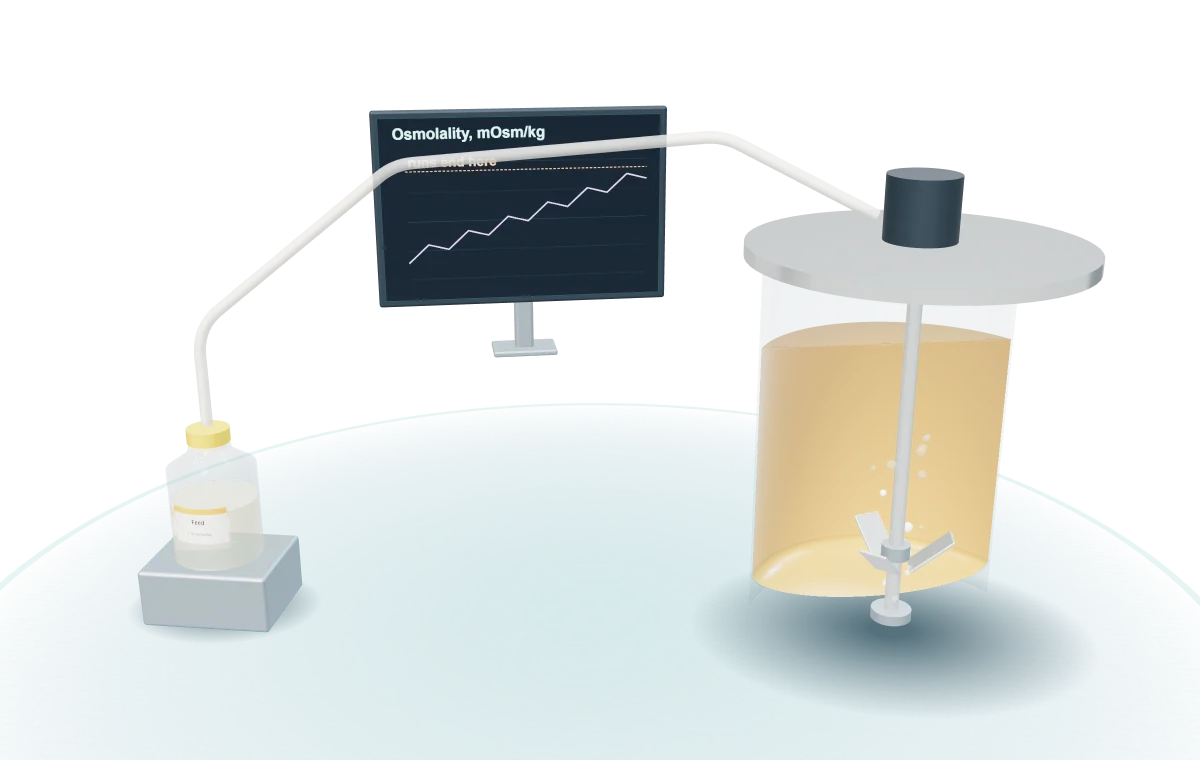
The vessel on the right of this figure is cut open, with a feed bottle on a stand at the left and a trend screen between them. Everything you add here stays. A fed-batch can end because the cells ran out of food, and it can just as easily end because of what you added trying to prevent that.
Serum used to do a great deal of quiet work. Supplying growth factors, carrying lipids, binding toxins, and protecting cells from shear. It also varied from lot to lot in ways nobody could specify, and it came from animals. Removing it meant replacing every one of those functions deliberately.
What replaced it is a chemically defined medium of more than eighty components. It is not cheaper. What it buys is a formulation you can describe completely. Glucose is held low on purpose, for the overflow reason in the last module. The poloxamer in there is a shear protectant, not an antifoam, and the two are constantly confused.
This bottle has two jobs that pull against each other. It has to deliver enough nutrient to support a population that doubles daily for the first week. And it has to do so without adding so much dissolved material that the broth stops being somewhere a cell wants to live.
Feeding too little is obvious and recoverable. The culture simply never gets there. Feeding too much looks fine for about a week and then takes the run away from you, and by the time it shows there is nothing to be done, because you cannot unadd a bolus.
Osmolality is the total concentration of dissolved particles. This feed is around 1,100 mOsm/kg and it goes in a few per cent at a time. Each addition steps the osmolality up, consumption claws a little of it back, and the trace walks upward across the fortnight.
Every bolus arrives through this addition port, and nothing is ever harvested, so the broth only goes one way. The run can end on the osmolality line rather than on nutrients, and that is the thing to design against.
Your turn. Tap the six additions, where each step is one bolus going in. Challenge: Which marker is the six additions, each a step up? Answer: The staircase of six additions (2).
A concentrated feed delivers the same nutrients in less volume, and that volume is the whole reason concentrates exist. A vessel takes only 20 to 40% of its starting volume as feed, and every litre you add dilutes the product you are trying to make.
Quick judgement, and almost everyone gets this one backwards. Take 1,000 L at 320 mOsm/kg and deliver the same nutrients either way. One feed is at 1,000 mOsm/kg, the other at 2,000. Where does the more concentrated feed leave the broth? Challenge: Same nutrients from a 1,000 or a 2,000 mOsm/kg feed. Where does the broth end? Options: Lower, because a concentrate adds less; Higher, at about 400 instead of 382; The same either way, because the osmoles are the same. Answer: Higher: about 400 mOsm/kg from the 2,000 feed against 382 from the 1,000 one.
The levers that genuinely lower the osmotic cost per gram of nutrient delivered are different ones. Reformulating out the salts, which are a fifth to a third of a typical feed's osmolality and which the cells get nothing from. And spreading the addition, so the culture never sees a step.
There is one more route to the same ceiling, and it needs no feed at all. In a small vessel, losing water concentrates everything that is left, so the osmolality rises without anyone adding anything.
One honesty note to end on. This course's book library contains no osmolality value anywhere. No working range, no excursion threshold, not one figure in milliosmoles. The ranges used here are ordinary practice, and the thresholds in the stations are guidance rather than published limits. Now design a feed against both numbers below.