Less oxygen, still short
A three-minute story with two challenges. Find the ceiling the gas sets, then find where cells actually die.
Read the transcript
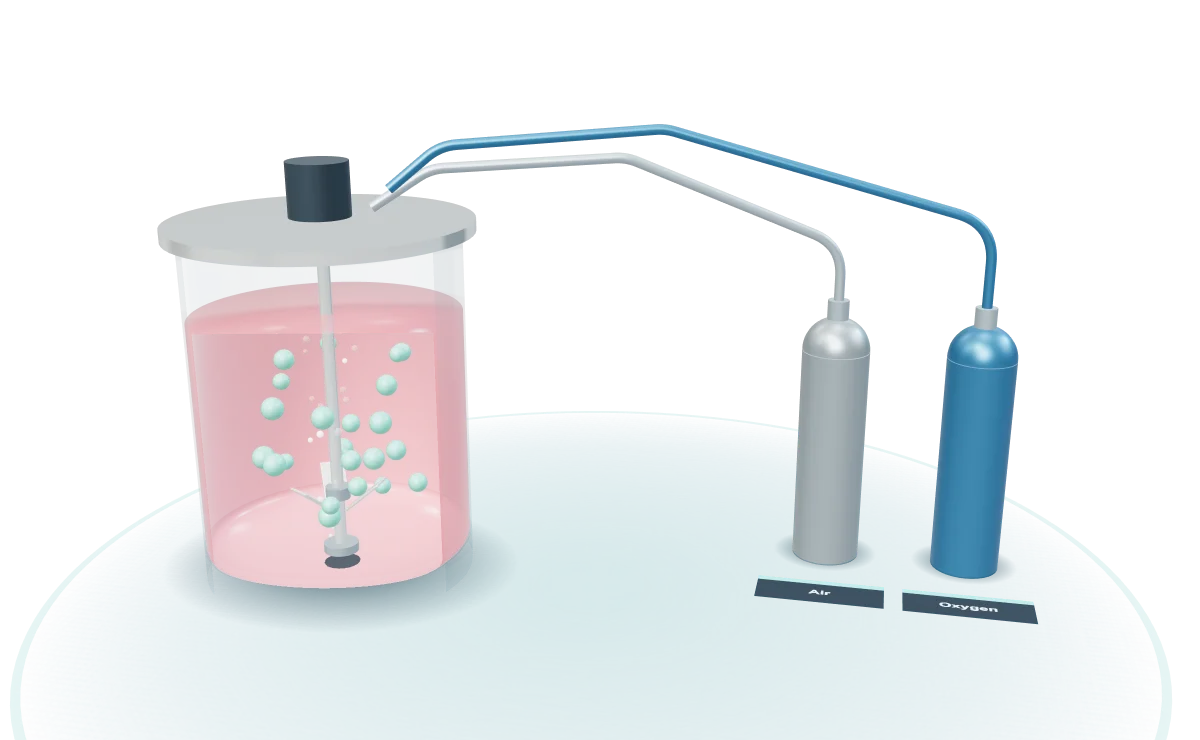
The vessel in this figure is cut open, with two gas cylinders standing beside it. A litre of CHO broth at 20 million cells per mL asks for about 6.6 mmol of oxygen an hour. A litre of dense E. coli broth asks for well over 100. And yet it is the mammalian vessel that runs short.
Demand comes from the cells, and it is a straight line through the origin. Double the cells and you double the oxygen consumed. Supply is flat. The controller holds the setpoint, so the driving force is fixed, and the microsparger delivers what the vessel and the gas allow. Where demand overtakes supply is a ceiling nothing in the feed strategy can lift.
The supply numbers are worth memorising. A mammalian stirred tank delivers roughly 5 to 25 per hour. A microbial fermenter runs 400 to 800. A spinner flask manages 0.1 to 4. Every instinct you brought from a fermentation needs rescaling.
Which is why the gas line carries oxygen and not just air. Air is 21% oxygen. Saturation is about 0.207 mmol/L in equilibrium with air at 37 C, and it scales with the oxygen fraction of the sparge gas, so pure oxygen multiplies it by nearly five. Nothing else has that kind of reach.
Both lines arrive at the same gas inlet on the headplate. On air alone, a mammalian tank runs out of driving force around 10 million cells per mL. And a higher dissolved oxygen setpoint makes that worse. Holding 60% leaves less driving force than holding 30%.
A convention that catches people. Your dissolved oxygen setpoint reads 40% while you are sparging pure oxygen. Forty per cent of what? Challenge: A 40% DO setpoint while sparging pure oxygen. Forty per cent of what? Options: Of saturation for pure oxygen, since that is the gas in the line; Of air saturation, because the convention does not change with the sparge gas; Of the maximum the probe can read. Answer: Of air saturation: 40% of about 0.207 mmol/L, whatever gas you are sparging.
Cells respire, so carbon dioxide comes out at roughly the rate oxygen goes in. In a mammalian vessel the gas flow is small by design, and carbon dioxide is far more soluble than oxygen, so it dissolves rather than leaving. What removes it is gas volume. In a two litre vessel a bubble reaches the top in a second or two. At two thousand litres it rises through metres of broth and arrives already carrying as much as it can hold.
And here the two requirements fight. The cheap fix for oxygen is to enrich the gas, which lets you meet the demand on less of it, and less gas strips less carbon dioxide out. Enrichment adds no carbon dioxide by itself. The gas, the p H loop and the osmolality from Module 4 are one system, not three.
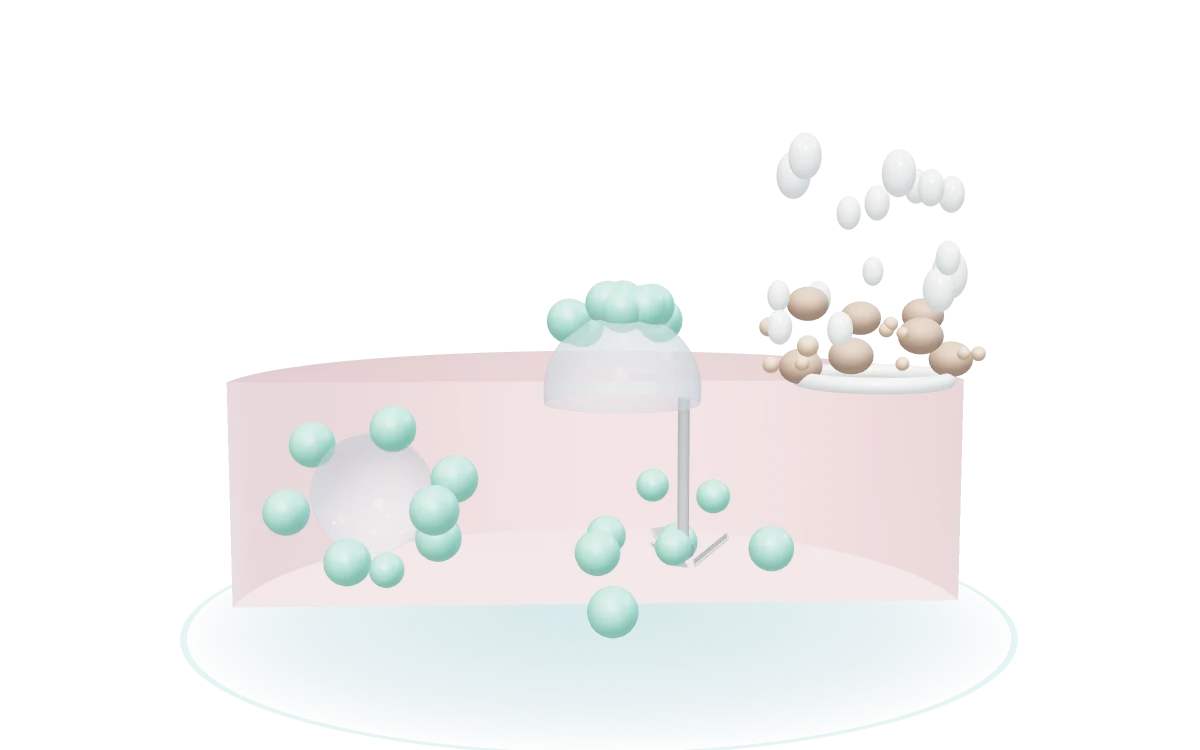
Now a cut block of medium, with its surface running across the middle. One caution first. The cells here are drawn about five times oversized relative to the bubble. At true scale a cell is roughly a hundredth of it and nothing here would be visible. At the left, a bubble rising through the bulk carries cells along and harms none of them.
At the surface it becomes a thin film, with cells caught in it. Then the film bursts, and the surface tension that snaps it back is what ruptures them. The debris and the dead cells are left at the rim. The cells that die are the ones that happened to be attached to it.
Your turn. Tap the moment where the cells are actually ruptured. Challenge: Where are the cells actually ruptured? Answer: The bursting film (3), at the liquid surface.
Meanwhile the impeller turns in the bulk, and the cells going past it are fine. A suspended CHO cell is on the order of 15 µm across, and the smallest eddies a normal mammalian vessel produces are larger than that, so bulk turbulence carries it along rather than tearing it.
So the poloxamer in your medium is a shear protectant, not an antifoam, and an antifoam would lower the mass transfer coefficient on top. This course prints no shear threshold, because the chapter in its library that promised one has no bioreactor hydrodynamics in it at all. Learn the mechanism and the levers instead. Now find your vessel's ceiling below.