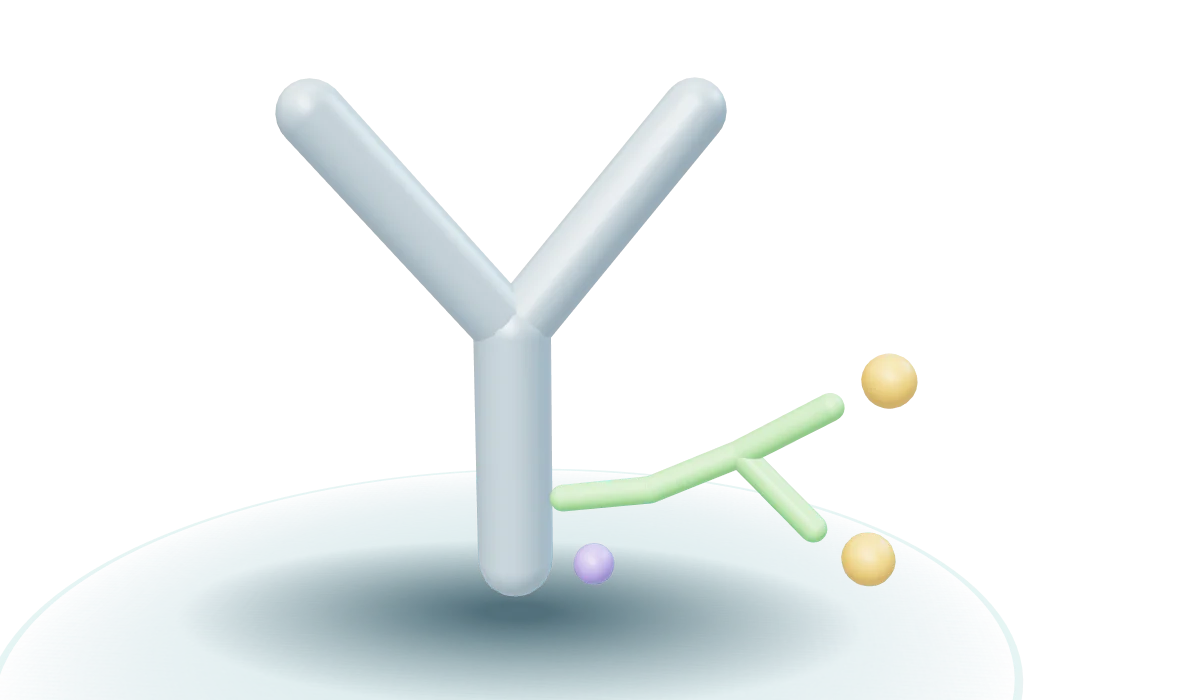
A protein with a glycan on it
A three-minute story with two challenges. Find the sugar that decides effector function, then price the temperature shift.
Read the transcript
In a fermentation the product is usually judged on how much of it there is and how pure it ended up. A therapeutic antibody is judged on a list, and the list is part of what the product legally is. Get the titre and miss the list and you have made something you cannot sell.
Four families account for most of that list. Cell culture conditions move the first three. The temperature you run at, the p H you hold, the ammonia you let accumulate and the day you harvest on all land on the attribute list, which is why this module sits after four modules about those exact decisions.
The vocabulary is worth getting right. A critical quality attribute is a property that must stay within an appropriate limit to ensure the product's quality, and that definition comes from ICH Q8. So does critical process parameter. Proven acceptable range and normal operating range are company convention, and a proven acceptable range is established one factor at a time.
Here is the product, drawn as linked capsules. A Y-shaped antibody, with two antigen-binding arms at the top. The glycan attaches in the Fc stem below, and it is not an impurity. It is part of what the product is. A branched sugar chain runs out from its core, and it changes how fast the antibody clears from serum and what effector function it has.
The terminal sugars on the ends of those branches are the part a temperature shift or an ammonia excursion reaches. Terminal galactose is linked to complement dependent cytotoxicity, and specifically not to the antibody dependent route, which is the one most people assume.
The core fucose sits at the base of the chain, and that is what decides the antibody dependent route. The lever there is afucosylation, and it does not appear in this course's book sources at all. High mannose is the other proportion worth stating: it is linked to faster clearance of the product from serum and to adverse events, which is why it usually carries a specification ceiling.
Your turn. Tap the sugar that decides the antibody dependent route. Challenge: Which part decides the antibody dependent route? Answer: Core fucose (5), at the base of the glycan.
And now the most important sentence in the module, in the book's own words. The effect of different glycosylation and charge variant forms on safety and efficacy remains unknown. So nobody can tell you which distribution is best for your antibody, and you are not asked to optimise one. You are asked to characterise what you make, show it stays the same, and justify the limits you set.
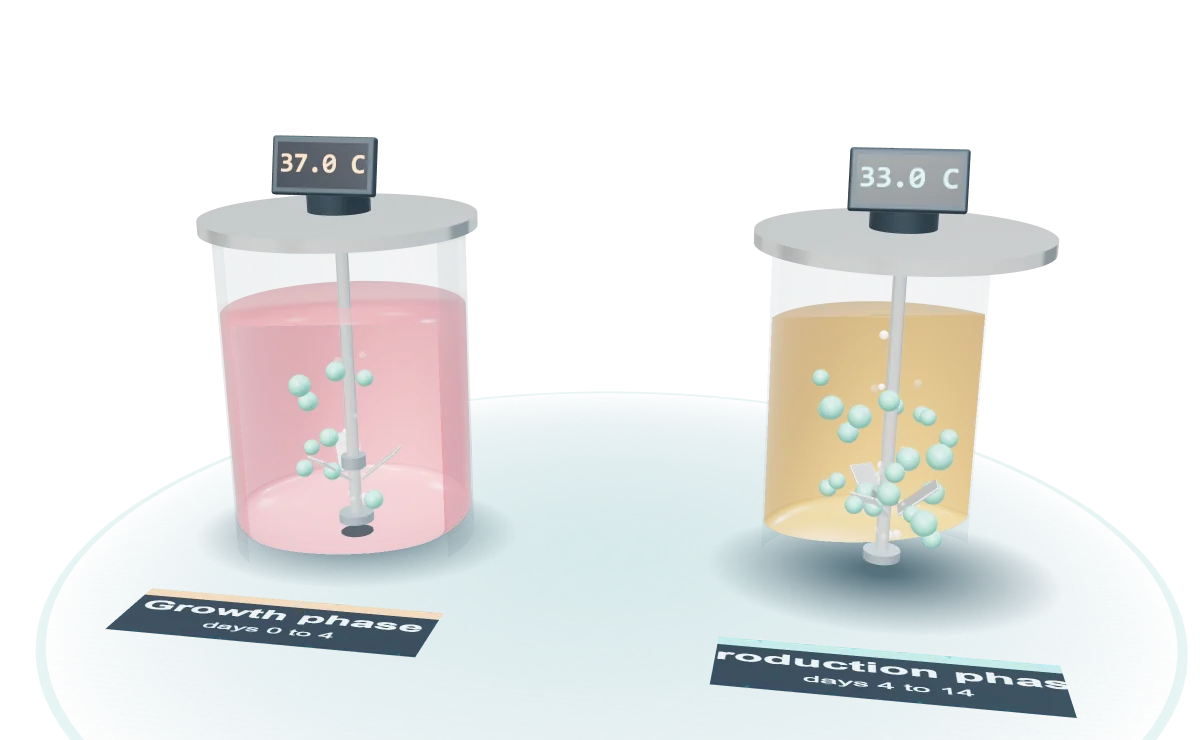
Here is the trade, in two cutaway vessels showing one run before and after. On the left, 37 C, the growth phase, days 0 to 4. Fewer cells in bright pink medium, and they are still dividing.
On the right, 33 C, the production phase, days 4 to 14. Many more cells, barely dividing, making product in spent amber medium. Growth nearly stops. Specific productivity rises by half again or more. Viability holds above 90% at day 14 instead of falling to 70%. And titre goes up by 20 to 40%.
And the glycan profile moves, by ten to twenty-five percentage points of galactosylation. That is not a side effect to be managed afterwards. It is the same decision, seen from the quality side, which is why the shift day belongs in a discussion about attributes and not only in a discussion about yield.
Timing is set by density rather than by the calendar. At what density is the shift normally triggered? Challenge: At what cell density is the temperature shift normally triggered? Options: About 2 million cells per mL; Six to ten million cells per mL; Above fifteen million cells per mL. Answer: Six to ten million cells per mL.
A later harvest and a generous feed carry footprints of their own, and the station below lays them out. Trade titre against quality knowingly, rather than by accident. Nobody can tell you which glycan distribution is best, which is why consistency is the target and not a maximum. Now sort the nine claims by evidence.