Heat and shear
Locate the cooling limit and compare turbulent length scales with a cell, a carrier and the gas–liquid interface.
You will be able to
- Compare metabolic and mechanical heat loads with jacket capacity.
- Interpret the effect of area per volume on cooling margin.
- Evaluate the limits of a shear estimate for suspended cells.
Find the jacket limit
Convert OUR to heat using an oxycaloric equivalent. Add the assumed mechanical heat input before comparing it with UAΔT. For a geometrically similar vessel, heat generation scales with volume while available sidewall area grows more slowly. Internal coils and external loops add heat-transfer area, with consequences for mixing, cleaning and circulation.
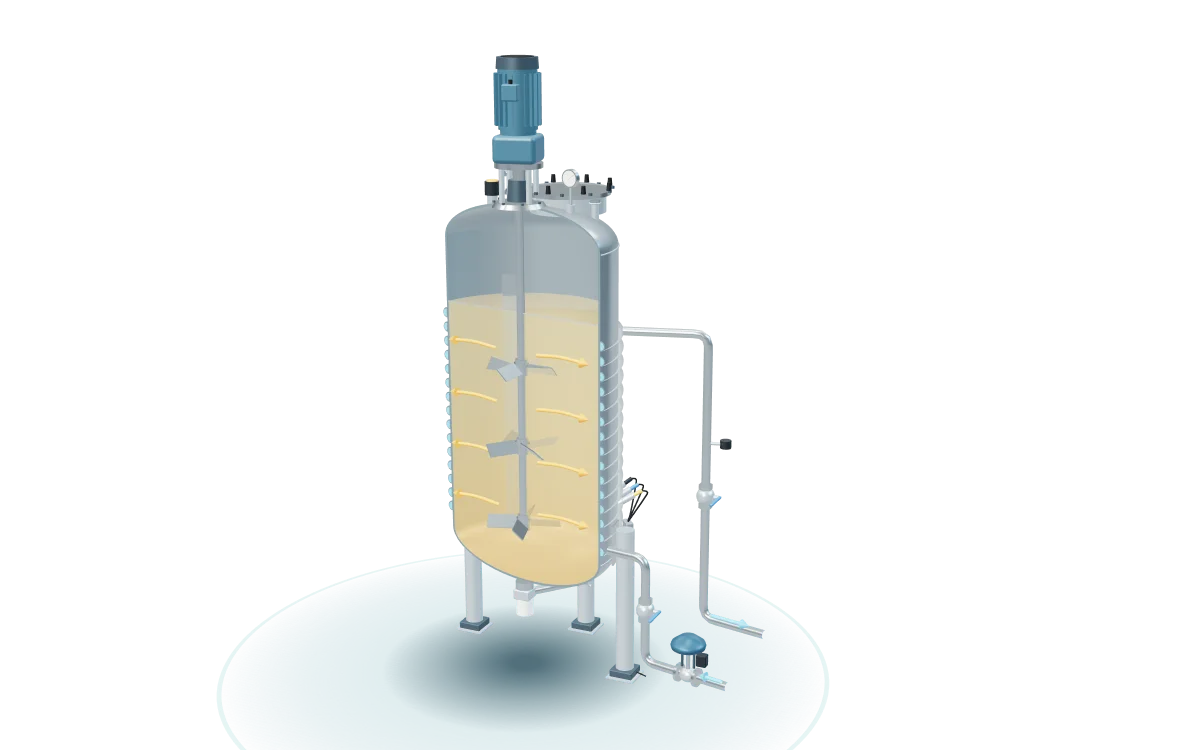
Heat from metabolism and agitation has to cross the vessel wall into coolant flowing through the half-pipe jacket. Jacket area grows more slowly than volume, so the cooling margin shrinks at scale.
- Heat flow from the broth to the wall
- Half-pipe jacket in section, with coolant inside
- Half-pipe coil on the outside of the shell
- Coolant supply control valve
- Coolant return with isolation valve
Quick check · 2 questions
Interpret an eddy length
The Kolmogorov length depends on kinematic viscosity and energy dissipation per unit mass. A whole-vessel mean cannot resolve the local peaks near an impeller or the stress at a bursting bubble. For suspended animal cells, surface bursting can be a major damage route. Protective surfactants can reduce cell–bubble interactions. Their suitability depends on the formulation and process.
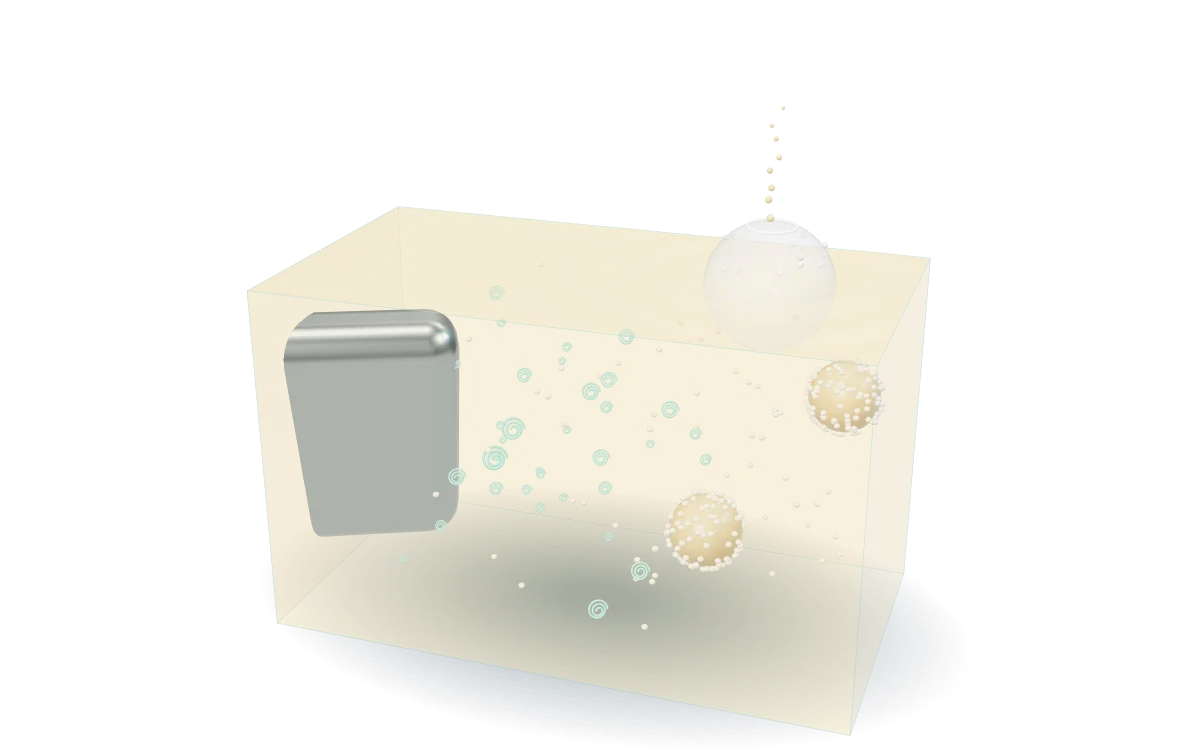
Close to an impeller blade the smallest eddies are a few tens of micrometres across: comparable to or larger than a single cell, but smaller than a microcarrier. A bursting bubble at the surface can be a major route of damage for suspended animal cells. Cells, carriers, eddies and the bubble are drawn to relative scale; the blade is not.
- Impeller blade tip, not to scale
- Small eddy, about 60 µm across
- A single suspended cell, about 15 µm
- Microcarrier bead, about 170 µm, with attached cells
- Bubble bursting at the liquid surface
Quick check · 2 questions
Practice and summary
Revisit your opening decision
oxycaloric equivalent · overall heat-transfer coefficient · cooling margin · energy dissipation · Kolmogorov length
Module flashcards
Confidence by objective
A low rating brings related cards forward for review.
Sources and further reading
Books and chapters
- M. Müller. “Heat Transfer in Bioreactors.” In M. Moo-Young (ed.), Comprehensive Biotechnology, 3rd ed., vol. 2. Elsevier, 2019. Chapter 2.12.
- M. Taya and M. Kino-oka. “Bioreactors for Animal Cell Cultures.” In M. Moo-Young (ed.), Comprehensive Biotechnology, 3rd ed., vol. 2. Elsevier, 2019. Chapter 2.37.
- C.-F. Mandenius (ed.). Bioreactors: Design, Operation and Novel Applications. Wiley-VCH, 2016. Chapter 11, P. Neubauer and S. Junne, scale-up and scale-down methodologies.
- R. Pörtner and J. Möller (eds.). Bioprocess Systems Engineering Applications in Pharmaceutical Manufacturing. MDPI, 2022. Contributions by F. Freiberger et al. on local hydrodynamics and T. Hernández Rodríguez et al. on seed-train design.
Papers and guidance
- F. Freiberger et al. (2022). New insights from locally resolved hydrodynamics in stirred cell culture reactors.
- T. Tharmalingam and C. T. Goudar (2015). Evaluating the impact of high Pluronic F68 concentrations on antibody producing CHO cell lines.
- IAPWS. Formulation for the viscosity of ordinary water substance.
Related BioProcess Tools pages
BioProcess Tools · Scale-up and scale-down · Module 5
Heat and shear
Takeaways
- Convert OUR to molar oxygen consumption per time before multiplying by an oxycaloric equivalent.
- Compare total metabolic and mechanical heat with UAΔT. Record the assumed coefficient and temperature difference.
- Kolmogorov length depends on kinematic viscosity and local dissipation. A vessel-average estimate masks local peaks.
- Consider sparger conditions, bubble rupture, foam and the particular cell system when interpreting shear risk.
Check your understanding
- Compare metabolic and mechanical heat loads with jacket capacity.
- Interpret the effect of area per volume on cooling margin.
- Evaluate the limits of a shear estimate for suspended cells.