Scale-down models
Choose a small system that reproduces the exposure relevant to a manufacturing decision, then test the response.
You will be able to
- Select a model for a defined transfer question.
- Interpret time-varying exposure in a compartment model.
- Choose evidence to qualify the model for its intended use.
Qualify a scale-down model
Start with the manufacturing question and the quality attribute it affects. A shake flask, a stirred microbioreactor and a small stirred tank offer different control over gas exchange, agitation and feeding. Compare kLa, P/V, pCO₂ and mixing where they are relevant. Then test whether the biological response and product quality support the intended use.
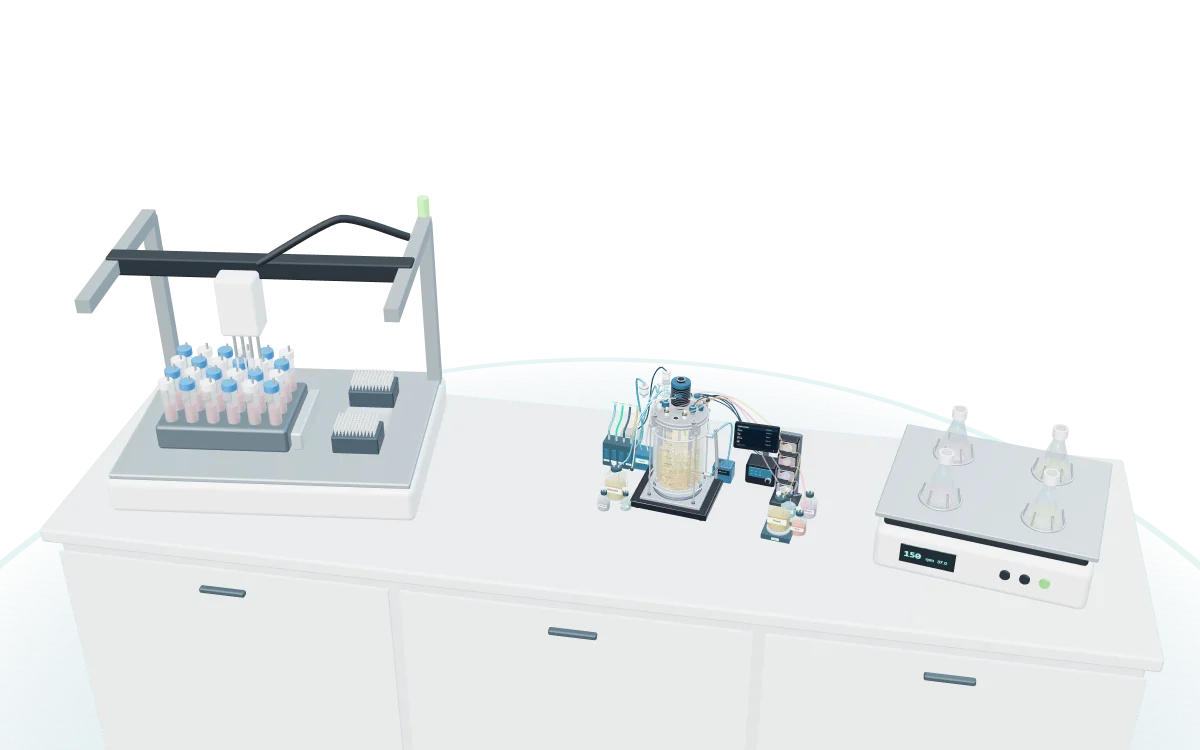
A stirred microbioreactor station, a 2 L benchtop bioreactor and shake flasks on an orbital shaker. They control gas exchange, agitation and feeding differently, so each has to be qualified for the question it is meant to answer.
- Block of miniature stirred vessels
- Liquid handler for sampling and feeding
- 2 L benchtop bioreactor
- Shake flasks on an orbital shaker
Quick check · 2 questions
Follow a cell through two zones
A single well-mixed vessel can reproduce the mean substrate concentration while missing repeated high-substrate or low-DO exposure. A two-compartment model separates a feed zone from the bulk and links them by a circulating stream. Vary the exposure time and effective input, then inspect the excursion seen by a travelling cell.
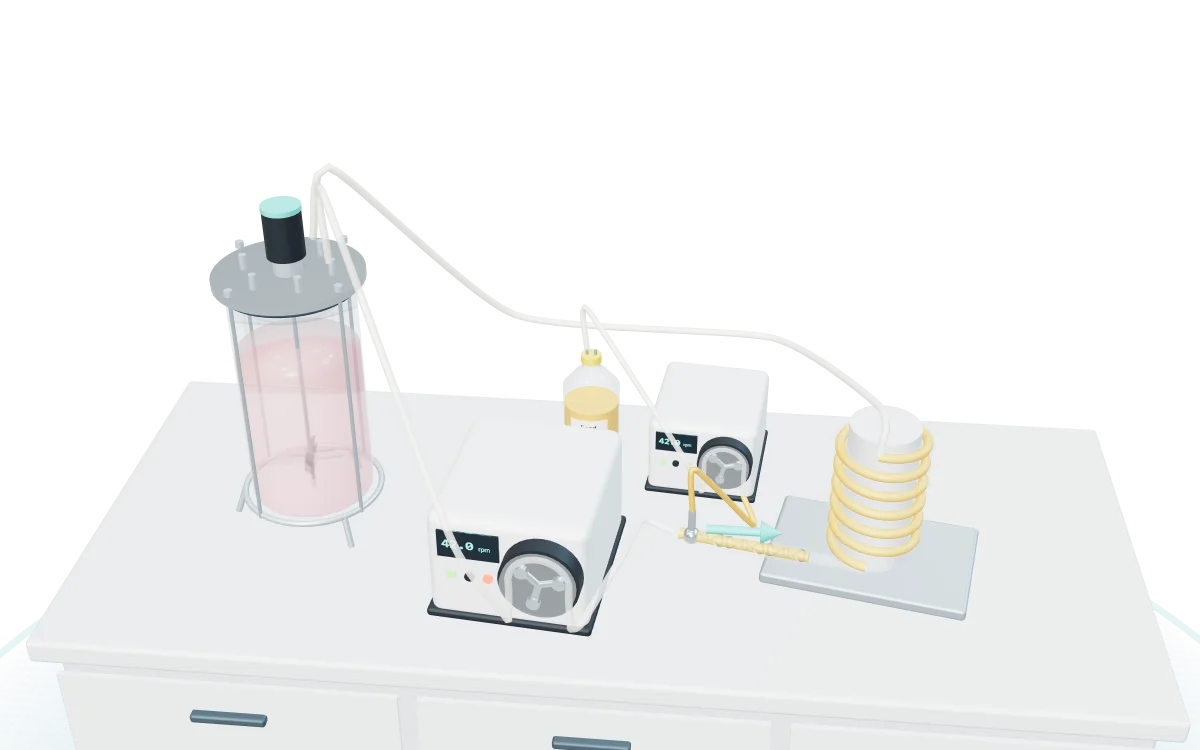
A stirred tank stands in for the well-mixed bulk and a pumped plug-flow section for the feed zone. Feed enters the plug-flow section, so cells pass through a high-substrate zone before they return to the tank.
- Stirred tank: the bulk zone
- Peristaltic pump setting the exchange flow
- Static mixer elements at the plug-flow inlet
- Coiled plug-flow section: the feed zone
- Feed injection point
- Return line to the tank
Quick check · 2 questions
Test equivalence against agreed margins
In a two one-sided tests procedure, predefine the acceptable difference for a specific attribute. At the 5% level per one-sided test, a two-sided 90% confidence interval wholly inside those limits supports equivalence under the test assumptions. A non-significant difference alone cannot establish that the models agree closely enough.
Quick check · 2 questions
Compare competing times
Express all times on the same basis. A mixing or circulation time longer than a local depletion time flags a region in which substrate or oxygen could run low. Use the duration and frequency of excursions to design a scale-down challenge and choose an observable response that could disprove the model.
Quick check · 2 questions
Identify the limiting regime
Design a scale-down exposure twin
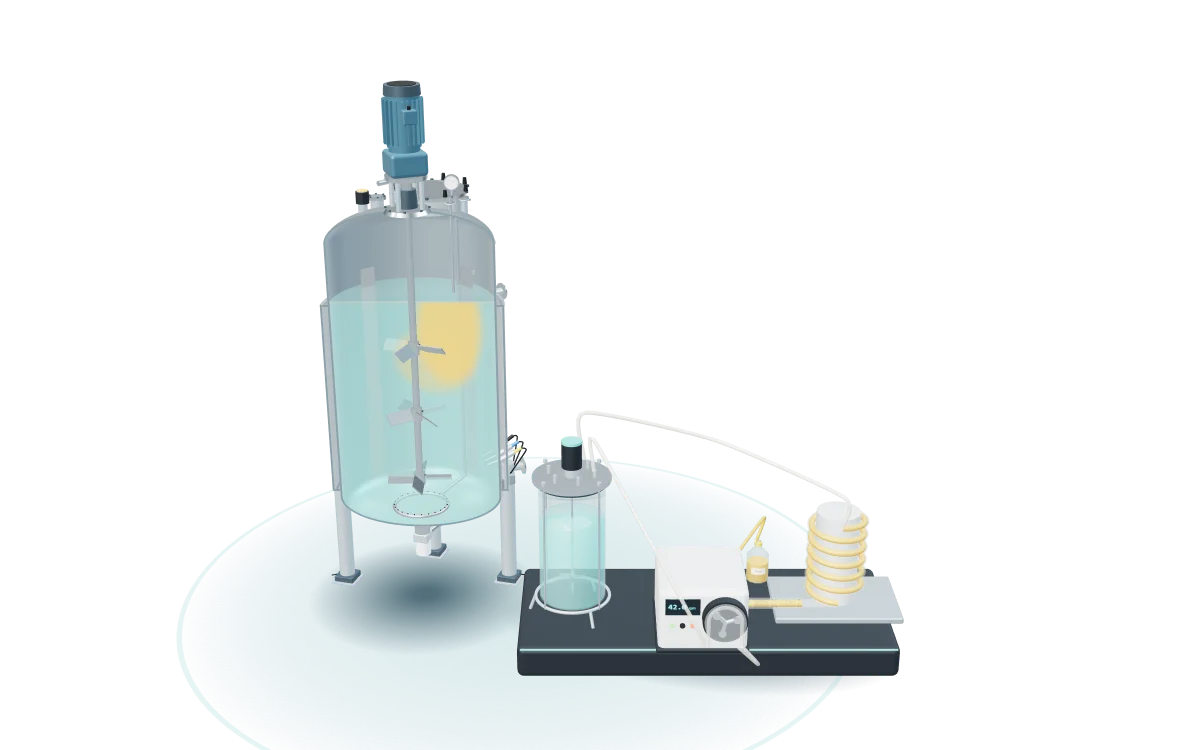
The amber feed zone under the surface feed point of the large tank is reproduced by the plug-flow section of the twin, and the teal bulk by its stirred tank. The twin copies the exposure a cell sees, not the shape of the vessel; it is drawn enlarged here.
- Feed zone below the surface feed point
- Well-mixed bulk
- Plug-flow section reproducing the feed zone
- Stirred tank reproducing the bulk
- Pump setting the residence time in the feed zone
Practice and summary
Revisit your opening decision
scale-down model · residence time · circulation time · model qualification · DO
Module flashcards
Professional flashcards
Open Professional deck
Confidence by objective
A low rating brings related cards forward for review.
Sources and further reading
Books and chapters
- W. Klöckner and J. Büchs. “Shake-Flask Bioreactors.” In M. Moo-Young (ed.), Comprehensive Biotechnology, 3rd ed., vol. 2. Elsevier, 2019. Chapter 2.24.
- P. Žnidaršič-Plazl and I. Plazl. “Microbioreactors.” In M. Moo-Young (ed.), Comprehensive Biotechnology, 3rd ed., vol. 2. Elsevier, 2019. Chapter 2.29.
- C. Herwig, R. Pörtner and J. Möller (eds.). Digital Twins: Applications to the Design and Optimization of Bioprocesses. Springer, 2021. Chapter by P. Neubauer and colleagues on model-based design of experiments and process analytical technology for scale-down.
- N. M. G. Oosterhuis, T. Hudson, A. D’Avino, G. M. Zijlstra and A. Amanullah. “Disposable Bioreactors.” In M. Moo-Young (ed.), Comprehensive Biotechnology, 3rd ed., vol. 2. Elsevier, 2019. Chapter 2.26.
Papers and guidance
- D. Lakens (2017). Equivalence tests, a practical primer for t tests, correlations, and meta-analyses.
- D. J. Schuirmann (1987). A comparison of the two one-sided tests procedure and the power approach for assessing the equivalence of average bioavailability.
Related BioProcess Tools pages
BioProcess Tools · Scale-up and scale-down · Module 6
Scale-down models
Takeaways
- Define which production behaviour the small system must reproduce before selecting the equipment.
- Match relevant gas transfer, mixing, pCO₂ and control behaviour and record unavoidable mismatches.
- Compartment exchange gives cells a time history of substrate and oxygen. A mean alone can hide its extremes.
- Qualify with process and product observations at the scales of interest. State the model’s scope.
Check your understanding
- Select a model for a defined transfer question.
- Interpret time-varying exposure in a compartment model.
- Choose evidence to qualify the model for its intended use.