Tech transfer and scale-up strategy
Review a proposed transfer, challenge the evidence for comparability and decide which risks need further work.
You will be able to
- Identify the limiting engineering and product risks in a transfer.
- Distinguish measured evidence from model predictions.
- Check the expansion and timing assumptions of a seed train.
Convene the scale-up review board
A proposed 200 L to 2,000 L transfer changes the vessel, the gas path and the available control actions. Review the fictional dossier. Identify the evidence gap, select a mitigation and say how its effectiveness would be checked. Compare single-use and stainless options against the actual geometry, available utilities, cooling surface and qualified operating envelope.
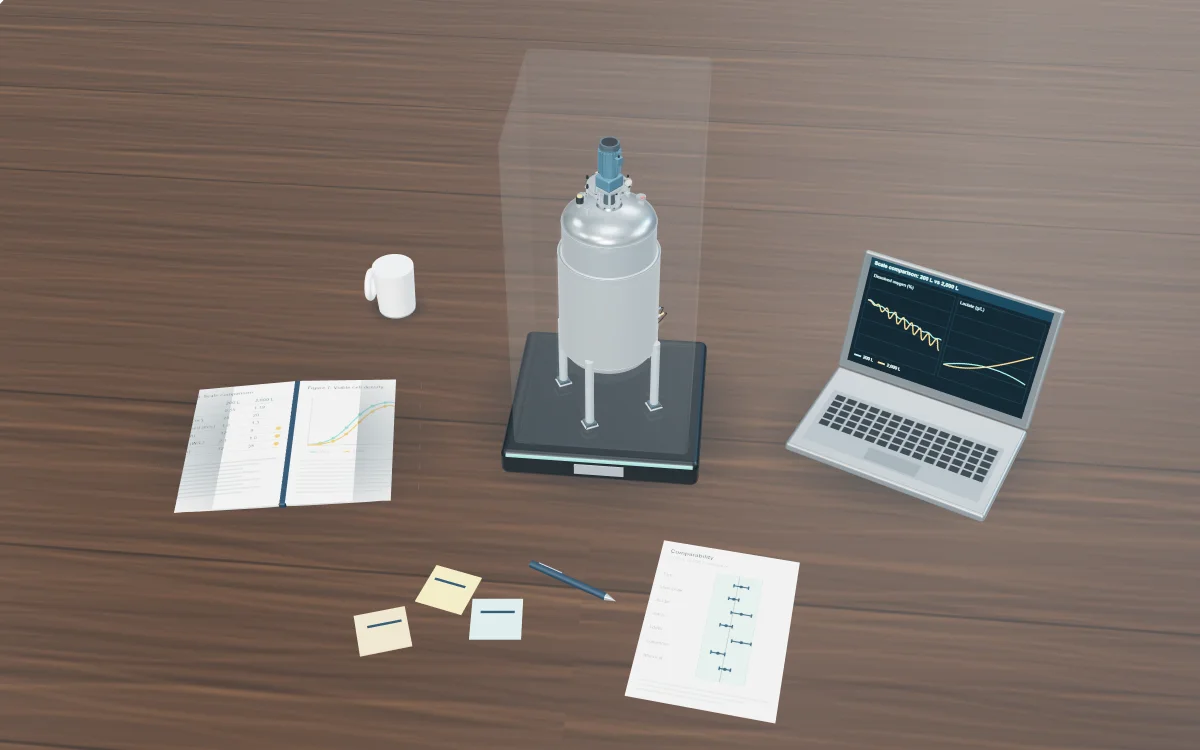
The review weighs the transfer report, trends from both scales and a comparability check against the geometry of the target vessel. Its job is to find the narrowest margin and the measurement that would resolve it.
- Transfer report open at the scale comparison table
- Report graph overlaying the two scales
- Laptop trends: 200 L and 2,000 L overlaid
- Scale model of the 2,000 L vessel
- Printed comparability chart with an equivalence band
- Sticky notes for open actions
Quick check · 2 questions
Read the published comparisons
In the alginate study, similar titre did not guarantee similar polymer molecular weight. In the CHO hydrodynamics study, equal mean P/V did not reproduce the same culture response in different impeller layouts. Compare the measured outcomes with the simulated local fields. CFD requires checks against observations and sensitivity to assumptions such as bubble size and mesh resolution.
Quick check · 2 questions
Review the seed train and comparability plan
The published CHO seed-train configuration used 38, 302 and 2,054 L bioreactors before a 9,500 L production vessel. The investigators used an industrial-data-based model to compare transfer strategies. A simplified constant-split calculation helps explain expansion and scheduling. The published sequence used unequal steps. Link the transfer plan to process characterisation, critical quality attributes and a comparability assessment.
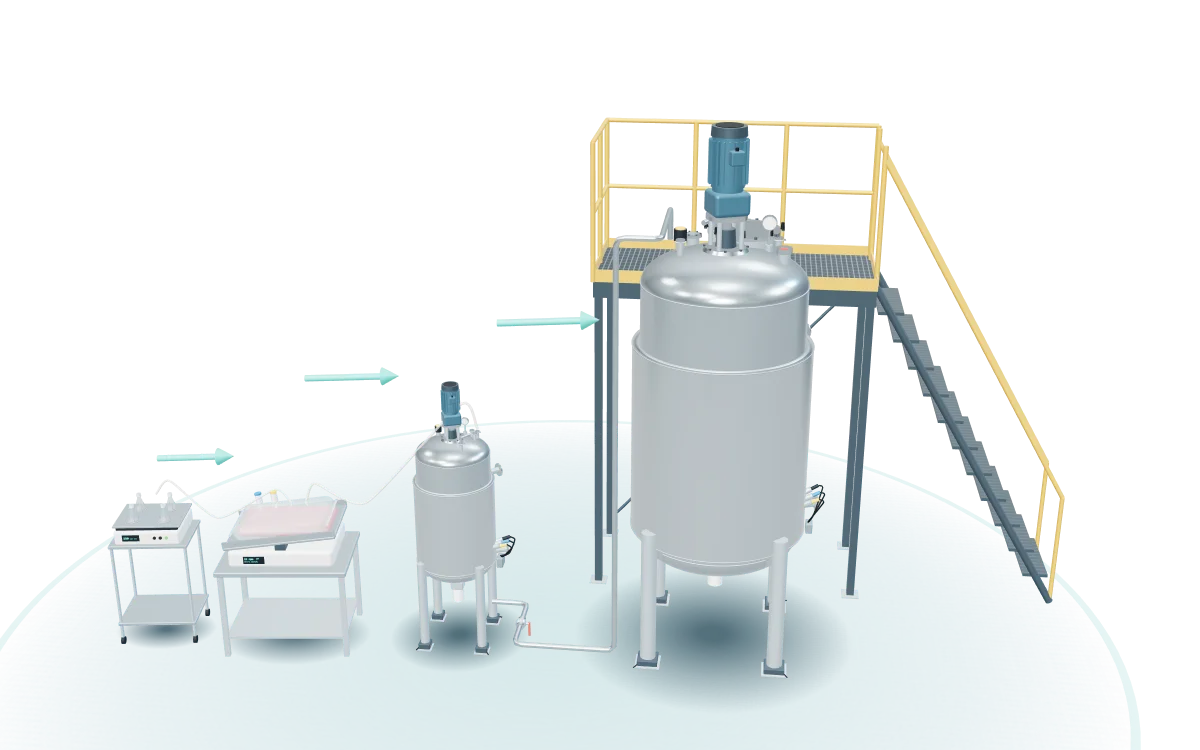
Cells are expanded step by step through shake flasks, a rocking bag, a 200 L vessel and the 2,000 L production vessel. Each transfer has its own volume ratio and its own timing window.
- Shake flasks
- Rocking-motion bag bioreactor
- 200 L stainless seed vessel
- 2,000 L production vessel
- Transfer line with isolation valve
Quick check · 2 questions
Build a 2 L to 2,000 L transfer worksheet
Practice and summary
Revisit your opening decision
CFD · comparability · CQA · seed train · split ratio
Professional flashcards
Open Professional deck
Confidence by objective
A low rating brings related cards forward for review.
Sources and further reading
Books and chapters
- Q. Li, C. Reeve, L. Martinez and S. Wright. “Scale-up in Biotechnology.” In M. Moo-Young (ed.), Comprehensive Biotechnology, 3rd ed., vol. 2. Elsevier, 2019. Chapter 2.62.
- R. Pörtner and J. Möller (eds.). Bioprocess Systems Engineering Applications in Pharmaceutical Manufacturing. MDPI, 2022. Contributions by F. Freiberger et al. on local hydrodynamics and T. Hernández Rodríguez et al. on seed-train design.
- R. Pörtner (ed.). Biopharmaceutical Manufacturing: Progress, Trends and Challenges. Springer, 2023. Chapter 9, quality by design.
- B. Ponce and colleagues. Chapter 18, alginate production at different scales. In S. P. Singh and S. K. Upadhyay (eds.), Microbial Bioreactors for Industrial Molecules. Wiley, 2023. Table 18.4.
Papers and guidance
- F. Freiberger et al. (2022). New insights from locally resolved hydrodynamics in stirred cell culture reactors.
- T. Hernández Rodríguez et al. (2022). Multi-objective optimisation applied to a biopharmaceutical seed-train design, including the configuration in Table 1.
- ICH Q5E. Comparability of biotechnological/biological products subject to changes in their manufacturing process.
- A. Díaz-Barrera et al. Production of alginate by Azotobacter vinelandii grown at two bioreactor scales under oxygen-limited conditions.
Related BioProcess Tools pages
BioProcess Tools · Scale-up and scale-down · Module 7
Tech transfer and scale-up strategy
Takeaways
- Rank transfer risks by the affected process or quality attribute and define evidence that could change the decision.
- Check what a model predicts and where it has been validated. A matched integral does not certify a local field.
- Use the alginate and CHO comparisons to distinguish titre, quality and local exposure from a matching engineering mean.
- Distinguish published seed-train configurations from simulated performance. Record working volumes, expansion assumptions and scheduling allowances.
Check your understanding
- Identify the limiting engineering and product risks in a transfer.
- Distinguish measured evidence from model predictions.
- Check the expansion and timing assumptions of a seed train.